Hiking Guide to the Hidden Birthing Cave in Sedona, Arizona (A Hidden Gem!)
Post summary: How to find the Birthing Cave and how to hike to this hidden cave in Sedona, Arizona
The Birthing Cave is one of Sedona’s most photogenic hidden caves—and while it was once a lesser-known spot, its popularity has surged thanks to social media.
Located on Mescal Mountain, this short and relatively easy hike offers incredible views with minimal effort, making it a must-do if you’re exploring Sedona.
At just 2 miles round trip with minimal elevation gain, the Birthing Cave hike is one of the easiest cave hikes in Sedona. But despite its simplicity, finding the cave can be tricky if you don’t know where to look. Plus, capturing the perfect photo inside the cave requires a little strategy.
In this guide, I’ll cover exactly how to find the trailhead, what to expect on the hike, what to pack, and how to photograph the cave’s unique shape.
Keep reading for everything you need to know before heading out on this stunning Sedona adventure!

.
Birthing Cave Hike Quick Facts
- Distance: 2.0 miles round trip
- Trailhead Location: Long Canyon Trailhead
- GPS Coordinates of the Birthing Cave: 34.91309, -111.83618
- Elevation Gain: 300 feet
- Estimated Hike Time: 1.5 to 2 hours
- Difficulty: Easy to moderate
- Red Rock Pass Required? No
Respect the Land: Leave No Trace at the Birthing Cave
The Birthing Cave is not an officially maintained trail—it’s a herd path, meaning it was created by hikers over time rather than by trail crews. Because of this, the area is especially fragile, with sensitive desert vegetation and loose rock that can be easily damaged by off-trail exploration.
Additionally, the Birthing Cave holds cultural and spiritual significance, making it important to visit with respect. Please be mindful of your noise level and avoid disrupting the natural environment.
To help preserve this beautiful place for future visitors, follow the Leave No Trace (LNT) Principles:
- Stay on the trail – Always stick to durable surfaces to prevent erosion and damage to plants.
- Pack out all trash – Even biodegradable waste like fruit peels can harm wildlife.
- Minimize noise – Keep voices low and respect the cave’s quiet, sacred atmosphere.
- Respect wildlife – Do not feed or disturb any animals in the area.
- Take only photos – Leave rocks, plants, and artifacts untouched.
- Minimize geotagging – Consider sharing general locations instead of exact coordinates to reduce overcrowding.
For more information, check out the Leave No Trace Social Media Guidelines to learn how to responsibly share outdoor spaces online.
About the Birthing Cave in Sedona
Cultural Significance
The Birthing Cave holds deep cultural significance for the Hopi people, who are native to the Red Rock Region of Sedona. According to Hopi tradition, their ancestors emerged from the center of the Earth, and due to its distinct womb-like shape, the cave was believed to be a place of spiritual rebirth and feminine energy.
Hopi women were said to visit the cave during pregnancy, climbing inside just before labor to sit, pray, and give birthin this sacred space. Today, many visitors still come to the Birthing Cave to reflect, meditate, and connect with the land’s spiritual energy.
The Birthing Cave is also believed to be part of Sedona’s vortex energy, which many say enhances introspection, healing, and transformation.
Why is it Called The Birthing Cave?
The name “Birthing Cave” comes from the Indigenous Hopi people, who traditionally used this cave as a sacred space for childbirth. Pregnant women would climb into the cave, sit, and pray before giving birth, believing that the cave’s energy supported new life.
But beyond its historical significance, the cave’s unique shape also plays a role in its name. If you look up at it from the canyon floor, you’ll notice striking anatomical similarities to the female reproductive system.
The cave is actually part of a larger rock formation on Mescal Mountain, known as “the mother.” The wider rock face resembles a womb, with the Birthing Cave itself forming the center. This makes it easy to see why the Hopi considered it a place of both literal birth and spiritual renewal.
Read next:9 Ways to Find Hidden Gems and Secret Hiking Trails
 .Hike to the Hidden Birthing Cave in Sedona, Arizona
The hike to the Birthing Cave is a 2-mile out-and-back trail that takes around 20 minutes one way if you’re walking at a moderate pace. But if you want to soak in the views (which you should), budget about 1.5 to 2 hours for the whole experience.
Overall, this hike is pretty easy since most of the trail is flat. The only real challenge is the final climb into the cave, which is short but can be a little steep and slippery.
And good news for dog owners – the Birthing Cave is a dog-friendly trail! We saw a few dogs at the cave, though some struggled on the smooth rock inside. If you’re bringing a pup, make sure they have good traction or are okay with being carried up the last section.
How to Get to the Birthing Cave Trailhead
The Birthing Cave trailhead is about a 15 minute drive from downtown Sedona, near other popular hikes like Devil’s Bridge and Fay Canyon. You’ll start your hike on the Long Canyon Trail, which leads to an unmarked turnoff toward the cave.
Finding the Trailhead
Some blogs claim the trailhead is tricky to find, but I had no issues using Google Maps. You can enter either:
“Birthing Cave Trailhead” (works on most apps)
“Long Canyon Trailhead” (same parking area)
However, you won’t have cell service once you get there, so download offline Google Maps before you go. (If you’re not sure how, check out my post on How to Plan a Road Trip Using Google Maps).
Parking at the Birthing Cave Trailhead
There’s no official parking lot, but there’s a small, unmarked dirt pull-off next to the trailhead. It only fits a handful of cars, and because Long Canyon Trail is a popular hike, the lot fills up fast.
If it’s full, you have a couple of options:
1. Keep driving down the road—there are a few more small dirt pull-offs where you can park.
2. Try the Mescal Trailhead, which is just around the corner and offers more parking (though it adds a little extra distance to your hike).
Trail Description: How to Hike to the Birthing Cave
The hike to the Birthing Cave starts from the Long Canyon Trailhead, located right next to the roadside parking area. The Long Canyon Trail is wide, well-maintained, and easy to follow, but keep an eye out for mountain bikers, as this is a popular multi-use trail.
Follow the Long Canyon Trail for about 0.6 miles until you reach a fork in the path. This is where you’ll need to leave the main trail to get to the cave.
Finding the Turnoff to the Birthing Cave
At the fork:
➡ Long Canyon Trail continues to the right, passing through a wooden fence.
⬅ The unmarked Birthing Cave Trail is on the left.
The turnoff can be easy to miss because it’s unmarked and often blocked by sticks and brush (likely placed there to discourage overuse). Step over the sticks and follow the narrow path leading toward the red cliffs ahead.
Pro Tip: The turn isn’t obvious, so I recommend downloading offline maps on AllTrails before your hike to avoid missing it.

From the turnoff, follow the unmarked path for about 0.3 miles.
The trail is well-worn and heads straight toward the red cliffs, so it’s fairly easy to follow. However, there are a lot of side trails branching off, so stay aware to make sure you’re on the correct path.
Always stay on the main trail to avoid damaging sensitive desert vegetation. The desert ecosystem here is fragile, and off-trail hiking contributes to erosion.

Spotting the Birthing Cave
As you approach the base of the cliffs, look up—you might be able to see the heart-shaped indent in the rock wall. That’s the Birthing Cave.
Personally, it wasn’t super obvious to me right away, so I was glad I had downloaded offline AllTrails maps and saved the GPS coordinates of the Birthing Cave: 34.91309, -111.83618. But on busy days, you’ll know you’re close when you start hearing voices echoing from inside the cave.
The Final Climb into the Cave
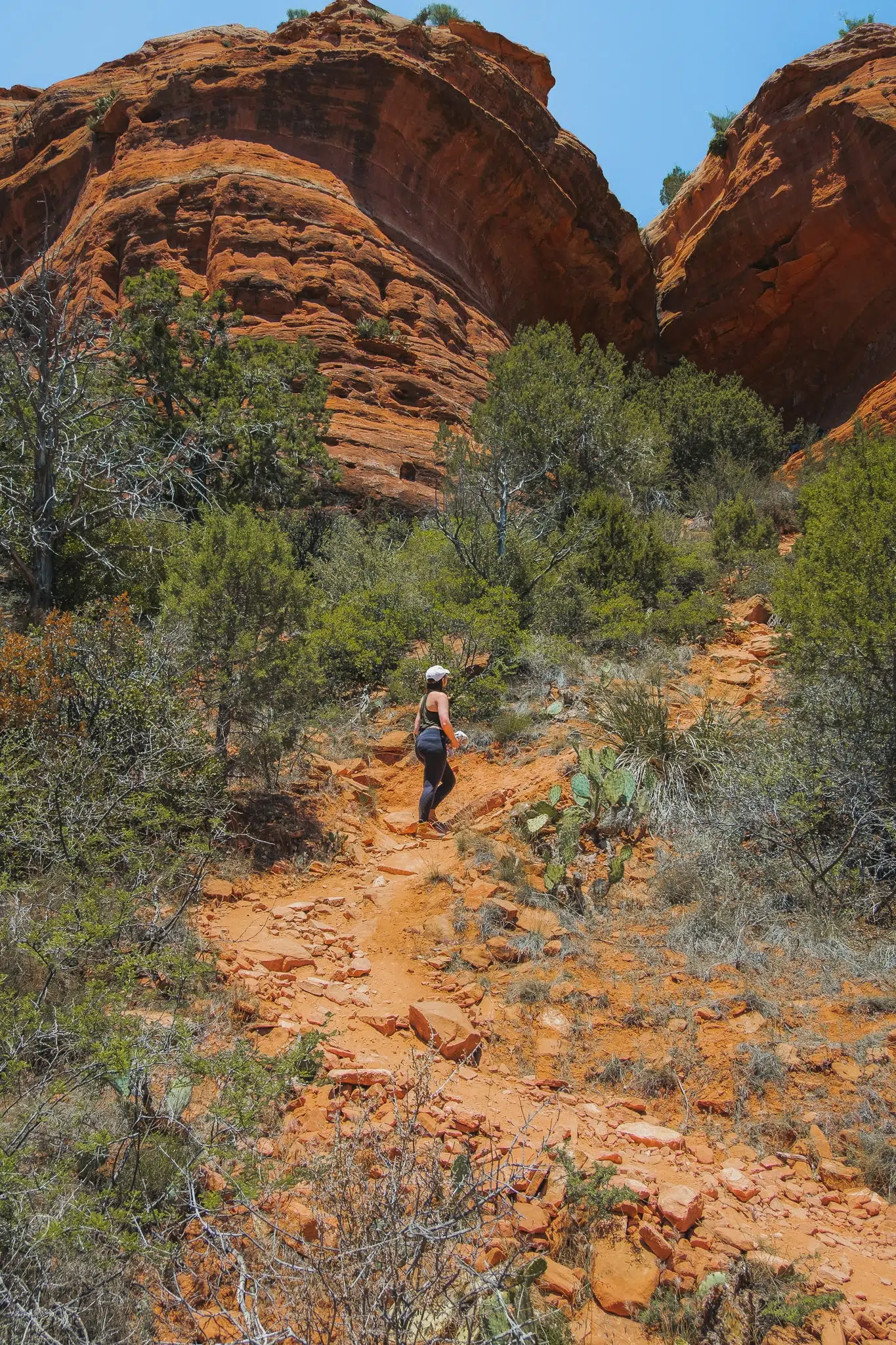
As you near the cave, the trail bends slightly to the right and then heads straight up into the entrance.
What to expect for the climb:
- This is the only steep section of the hike. Up until now, the trail has been mostly flat.
- The footing can be slippery, especially on loose dirt and smooth rock.
- Watch for hikers coming down—the cave is small, and people often take turns entering and exiting.
Take your time scrambling up, and get ready for one of Sedona’s most unique cave views!
.
Exploring Inside the Birthing Cave
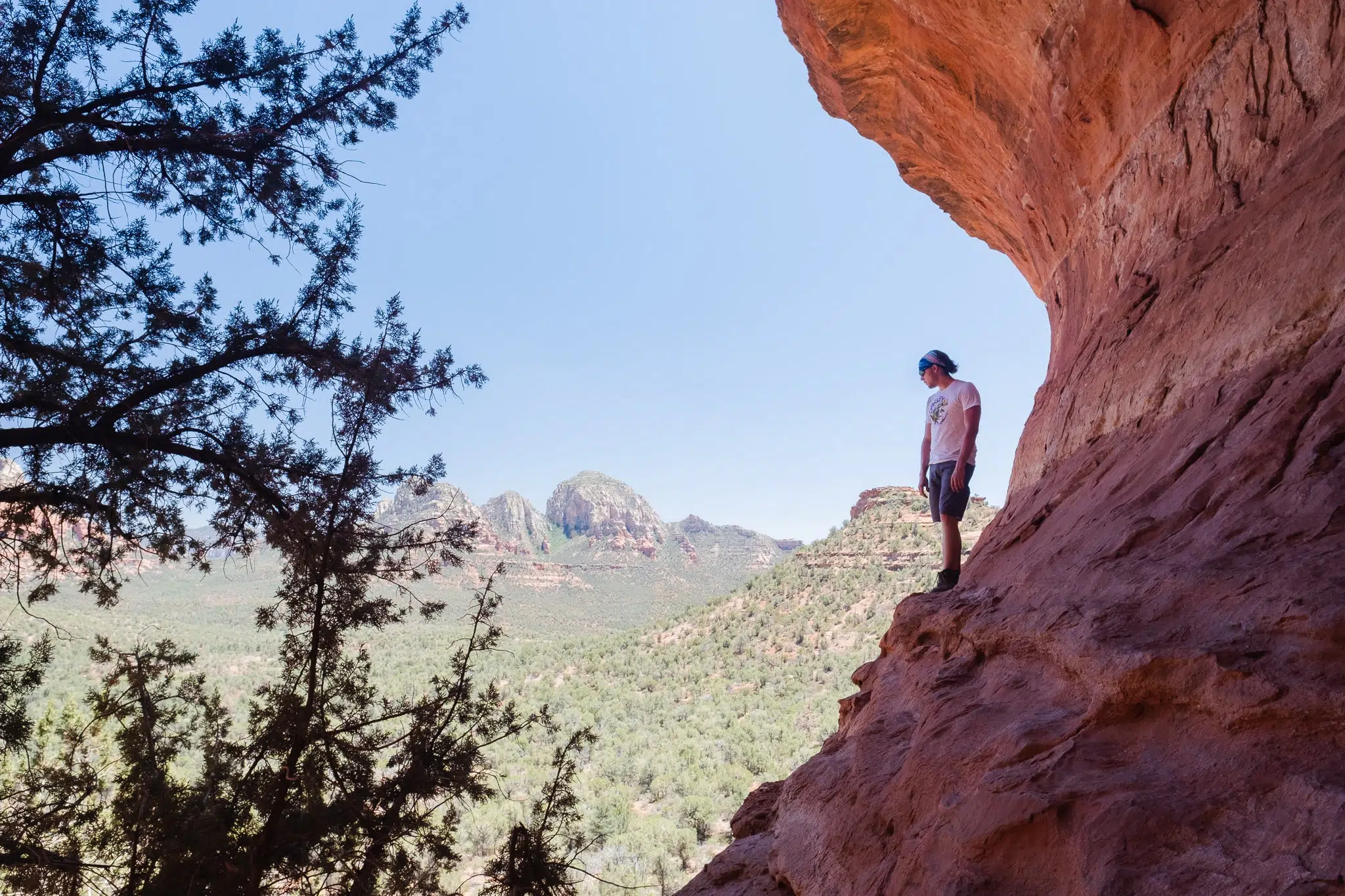
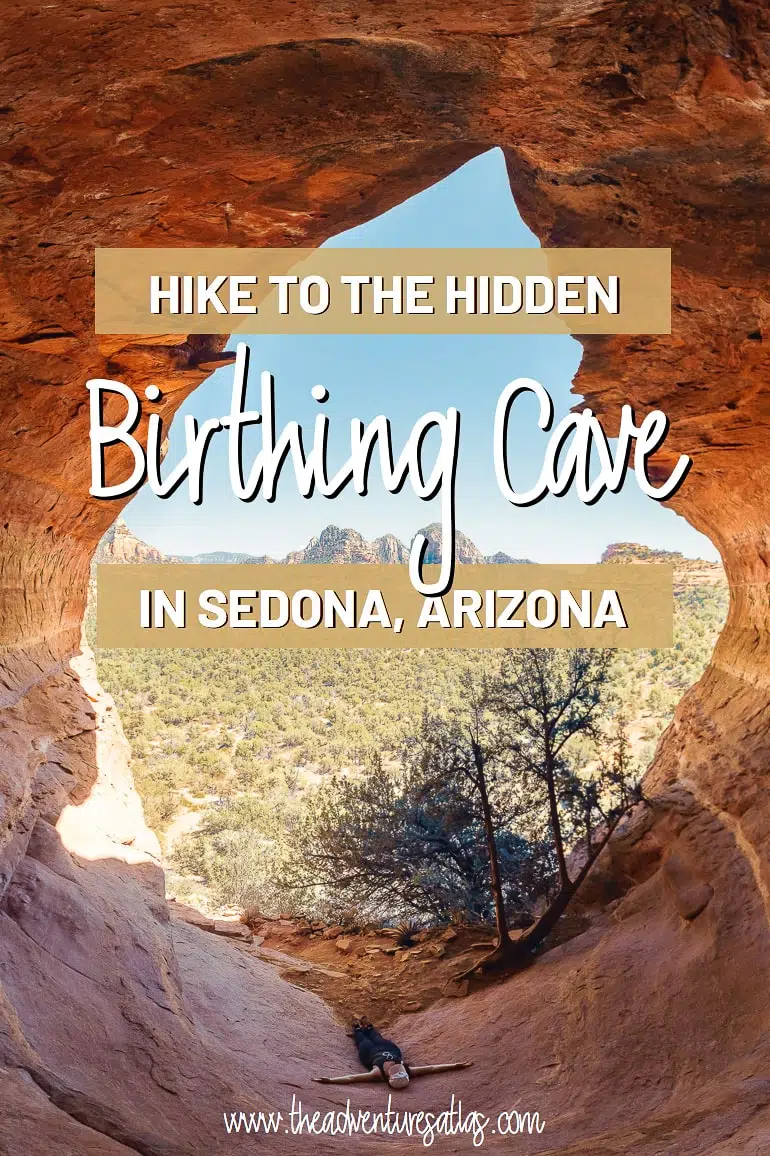
First things first: The Birthing Cave looks nothing like it does in most Instagram photos. Those pictures can make it seem like a deep tunnel, but in reality, it’s shallow and open at the top—more of a depression in the rock than an actual cave.
In fact, we didn’t even realize we were inside at first until we turned around and saw the stunning panoramic view of Sedona framed by the cave’s opening.
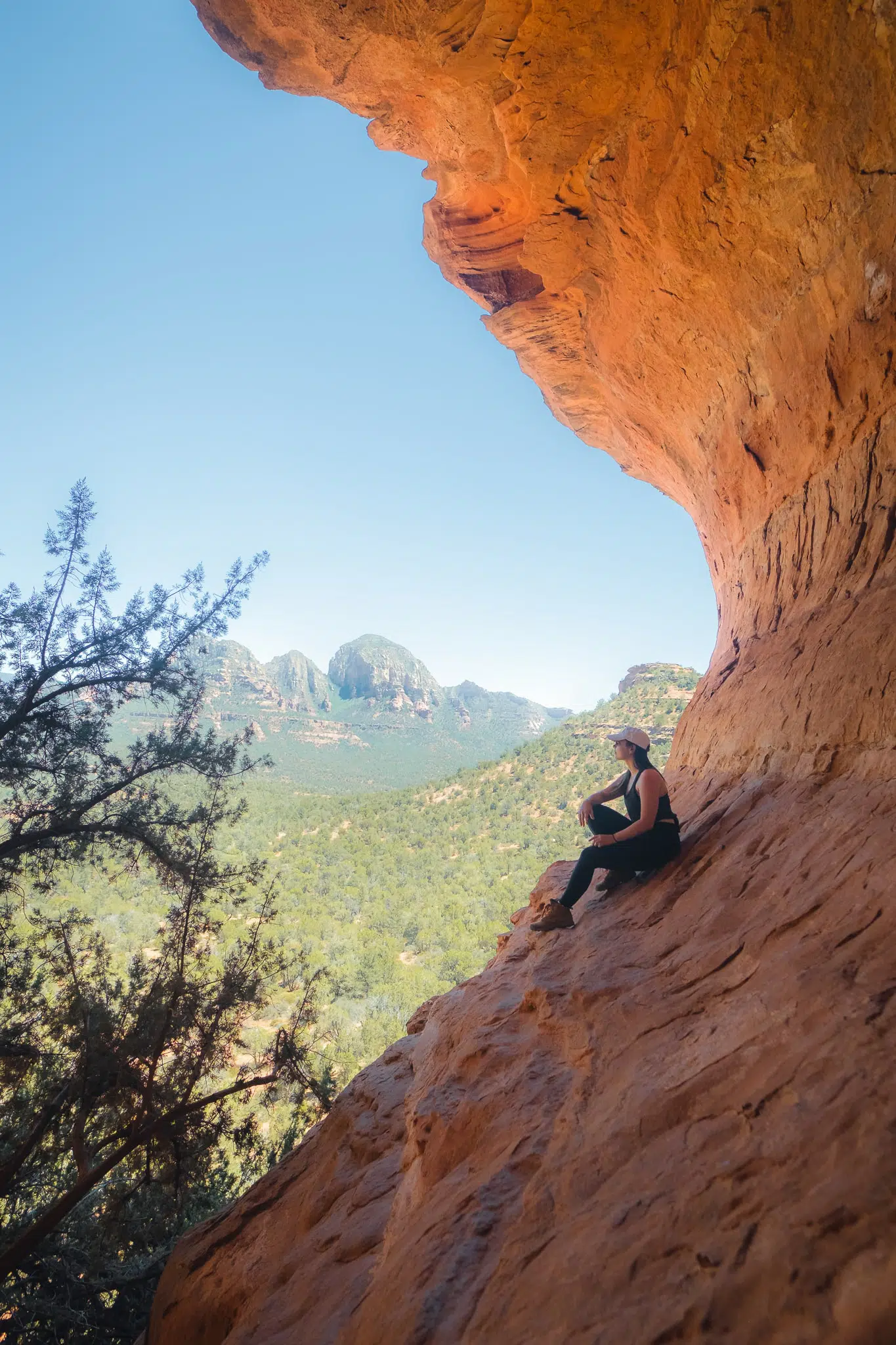
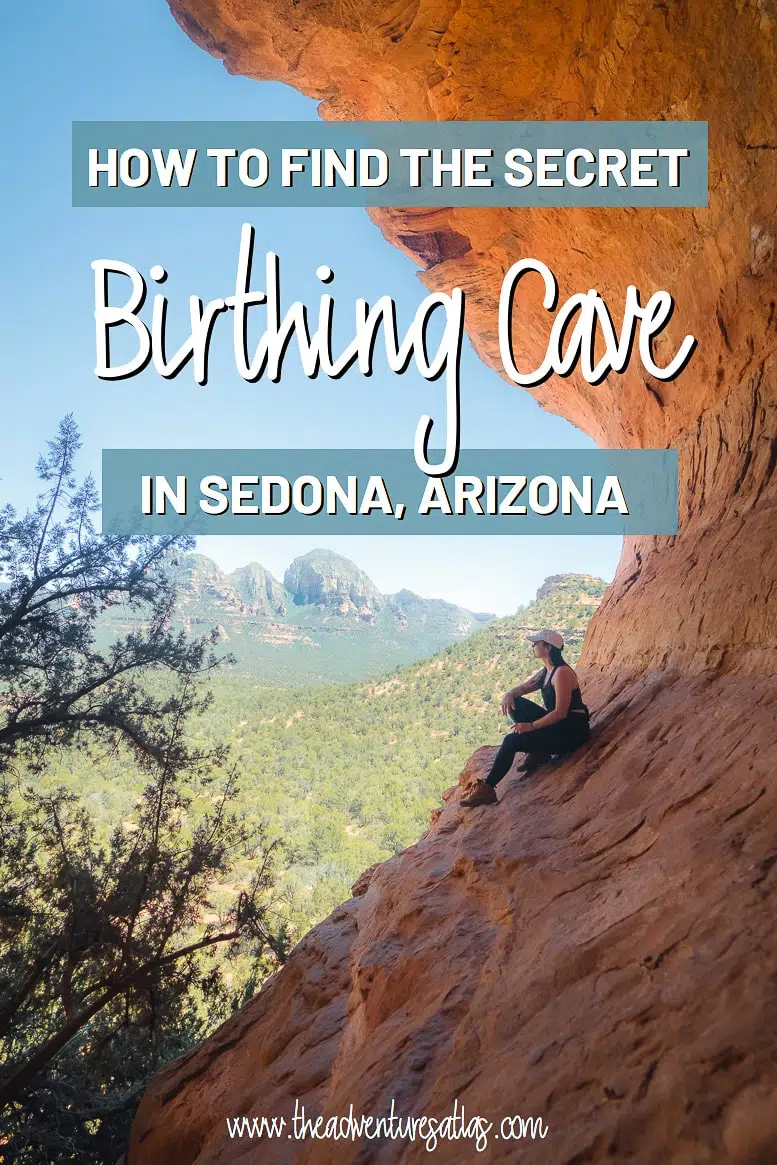
The red rock walls are steep and naturally rippled, creating ledges you can climb onto for better views. There’s not much room to explore, but you can crawl or step along the ledges to find the best vantage point.
Pro tip: Climb just a few feet up the walls to get above the shrubs that partially block the entrance. You don’t have to go high – just enough to clear your line of sight for the best Sedona vista.
✔ The rock is slippery in spots, so having grippy hiking boots will make a huge difference.
✔ Be mindful of other hikers—the cave is small, so take turns if people are waiting for a photo op.
The “Belly Button”: The Best Photo Spot
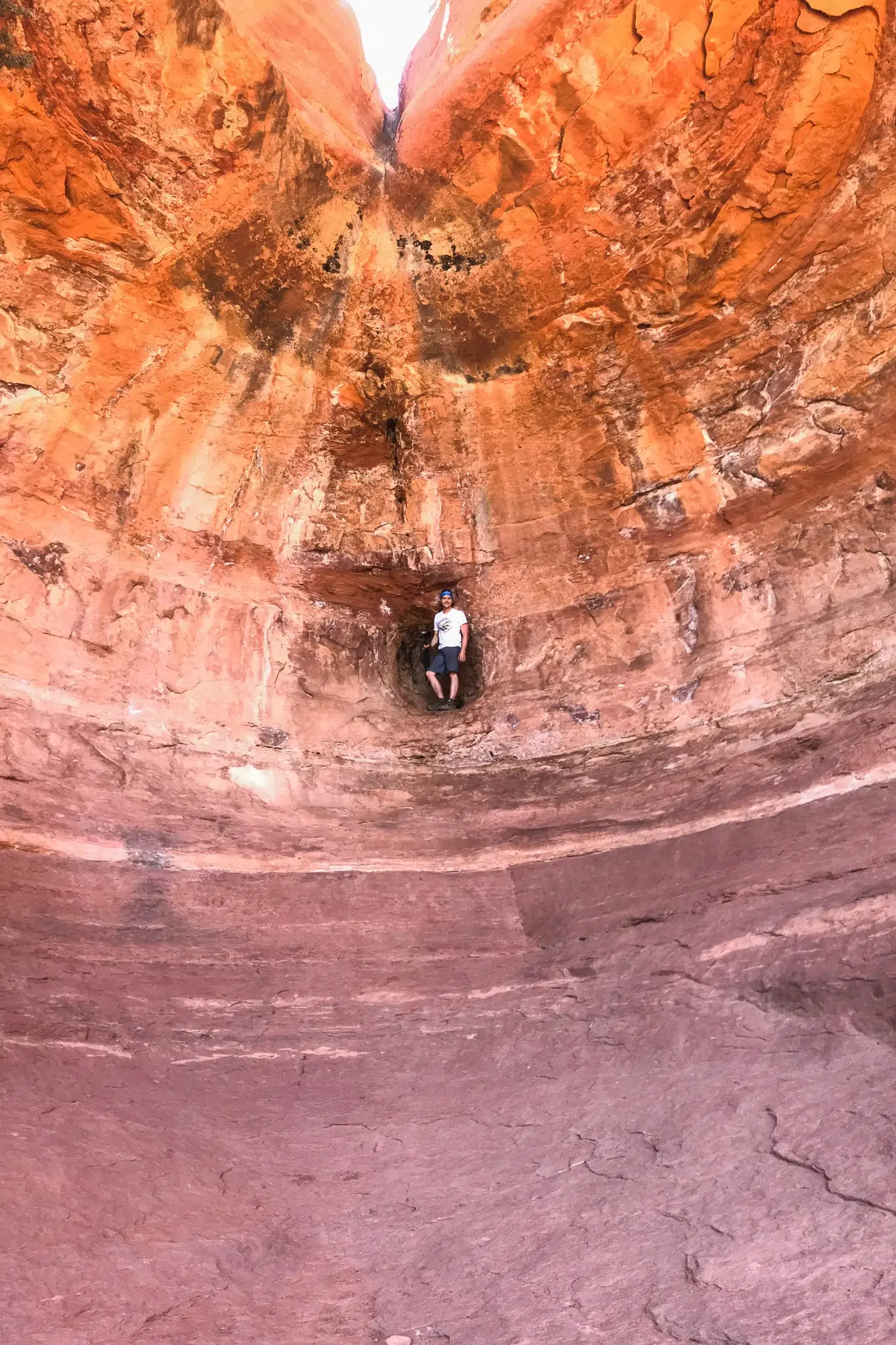
At the back of the cave, there’s small circular depression in the rock, commonly called “The Belly Button.” This is where everyone takes the iconic Instagram shot of the cave entrance. From this angle, the cave forms a distinct heart shape around the Sedona landscape.
Want to capture that famous Instagram photo? Keep reading for some photography tips!
How to Take Photos Inside the Birthing Cave
Contrary to what Instagram has lead you to believe, the Birthing Cave is not nearly as deep as it appears. It’s actually more like a sideways bowl with an open top, which makes it tricky to capture in a single shot.
Best Camera Gear for the Birthing Cave
Use a super wide-angle lens! To get the full cave entrance in one frame, you need something in the 10-16mm range. A GoPro or your phone’s vertical pano mode can also work in a pinch.
What if you don’t have a wide-angle lens?
No worries – we didn’t either! The widest lens we had was a 32mm, which wasn’t wide enough. Instead, we set up a tripod and took 13 separate photos around the cave, then stitched them together with Lightroom’s merge feature. The final result was seamless Insta-worthy shot. And it’s one of my favorite hiking photos to date! Whatever works, amirite?
Best Photo Spots in the Birthing Cave
The Belly Button (Best for the “Portal” Shot)
- The most famous photo spot is from the Belly Button—a small depression at the back of the cave.
- From this angle, the cave entrance frames the Sedona landscape in a perfect heart shape.
- Getting up there isn’t easy—the rock is super slippery, so make sure you have grippy hiking boots to climb safely.
Ledges Along the Cave Walls
- If you don’t have a wide-angle lens, you can still get great shots from the ledges on either side of the cave.
- These spots give you a unique perspective of the cave’s texture and depth without needing fancy camera gear.

Best Time to Visit the Birthing Cave
The Birthing Cave is worth visiting year-round, but thanks to social media, it’s getting increasingly popular—so don’t expect to have it all to yourself, especially in peak season.
Best Season to Visit
- Peak Season (March–June & September–November) – Expect more crowds and limited parking, especially on weekends.
- Off-Season (Winter & Mid-Summer) – If you want a better chance of having the cave to yourself, visit in January–February or July–August when fewer people are hiking.
If visiting in summer, go early in the morning to avoid the heat! Sedona temps can easily hit 100°F in July and August.
Best Time of Day to Visit
- Sunrise: Fewer crowds and cooler temps, but the cave will be shadowed since it faces southeast.
- Midday (Around 2 PM): Best lighting inside the cave, but expect more people. Our photos were taken around this time!
- Sunset: The Sedona landscape looks incredible, but the cave itself will be darker inside.
For the best experience, aim for just after sunrise to avoid crowds or mid-afternoon for even lighting inside the cave.
Top Tips for Visiting the Birthing Cave
Before you head out, here are my top tips to make the most of your hike to this hidden cave in Sedona:
1. Bring a Wide-Angle Lens – If you want to capture the entire cave entrance, you’ll need a lens around 10-16mm. If you don’t have a camera, a GoPro or the vertical pano mode on your phone can also work. The newest iPhones have an ultra-wide mode, which might be enough, but I haven’t personally tested it, so don’t quote me on that.
2. Pack Plenty of Water – This is a MUST. Even though the hike is only one mile each way, there’s no shade at all until you get inside the cave.
3. Arrive Early for Parking: The Long Canyon Trailhead parking area is small and fills up quickly. Get there early in the morning to secure a spot, especially during peak season.
4. Download Offline Maps: Cell service is unreliable, so download offline maps on Google Maps and AllTrails before you go. It’ll help ensure you don’t miss the turnoff to the cave.
5. Wear Grippy Hiking Boots: The hike itself is short and easy, but the final scramble into the cave is slippery. Proper hiking boots make a huge difference. If you’re in sneakers or sandals expect to slide right down the rock.
6. Watch for Wildlife: Rattlesnakes and javelinas are super common on Sedona trails. We actually passed a rattlesnake sunning itself right next to the trail on our way to the Birthing Cave. Stay aware, stick to the worn trail and always give wildlife plenty of space.
7. Follow Leave No Trace: The Birthing Cave is a sacred and special place, so always respect the land and other visitors. Follow the seven Leave No Trace Principles—stay on the trail, pack out all trash, and leave this incredible spot better than you found it..
Popular Sedona Hikes Nearby
Not ready to leave yet? Can’t say I blame you. Luckily, the Birthing Cave is just a short drive from several other must-do hikes in Sedona.
- Soldier’s Pass Trail – 4.5 miles, moderate. This scenic loop leads you to hidden caves, caverns, and stunning views. It’s a great mix of Sedona’s best landscapes.
. - Cathedral Rock – 1.4 miles, difficult. This is a Sedona classic, especially for sunset. While it’s short, this hike is more of a climb than a walk. Expect a steep, hands-on scramble to reach the top. But trust me, the views are worth it.
. - Bell Rock – 1 mile, moderate. Perfect if you’re looking for a quick but rewarding hike. It’s a short and steep scramble with incredible panoramic views, which makes a great addition to your Birthing Cave adventure.
. - Devil’s Bridge – 3.9 miles, moderate. You’ve definitely seen photos of this iconic sandstone arch. It’s a must-do, but only if you get there at sunrise. Otherwise, be prepared for a long wait just to snap a photo on the bridge (seriously the line was backed up about 3/4 of a mile just an hour after sunrise).
. - Subway Cave via Boynton Canyon Trail – 6 miles, moderate. This used to be a hidden gem, but not anymore! This hike leads to a unique red rock cave and ancient ruins, making it one of the most fascinating spots in Sedona. If you go, please practice Leave No Trace to help protect this special place.
.Is a hike to the hidden Birthing Cave in Sedona Arizona on your travel wishlist? Have you been there before? Let me know in the comments! I love to hear from you!
Don’t forget to pin for later
Related Posts


WANT TO SAVE MONEY TRAVELING?
Check out my list of reliable budget-friendly travel resources that are guaranteed to save you the most money, without compromising your experience.