The Perfect 2-Day Yellowstone Itinerary
So you’re wondering how to spend 2 days in Yellowstone National Park? Perfect – you’ve come to the right place!
After road-tripping through the park in a campervan, I learned exactly how to structure an adventurous 2-day itinerary that packs in all the highlights without feeling rushed. This guide gives you a logical route designed to hit all the highlights and still maximize your time.
This guide has everything you actually need to see it all – from the iconic Old Faithful and Grand Prismatic Spring to the best spots for wildlife viewing in the “Serengeti of North America.”
And don’t forget to grab my free Yellowstone National Park road trip itinerary download before you go!
Let’s get started.
Your 2-Day Yellowstone Itinerary: At-a-Glance
- Day 1: Geysers & Wildlife. This day focuses on the Lower Loop, hitting the park’s most famous geothermal basins before ending with a sunset safari in Hayden Valley.
. - Day 2: Canyons & Valleys. This day covers the Upper Loop, including the magnificent Grand Canyon of the Yellowstone, before heading north to the unique terraces of Mammoth Hot Springs and the wildlife in Lamar Valley.
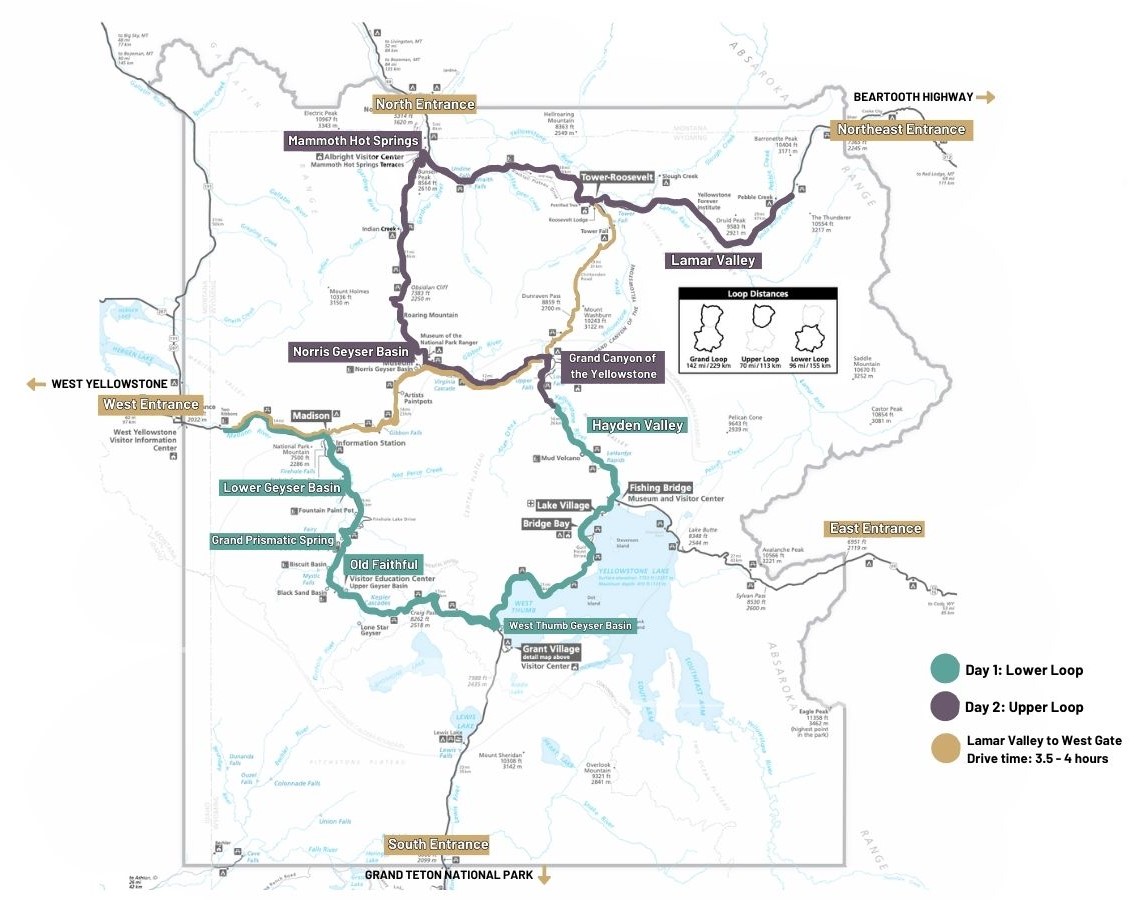
Important: This is a summer itinerary and is best completed from Mid May – early October when the roads in Yellowstone are open. Check the National Park Service website for up to date information on road closures, road work, and current road conditions before you go.
What to Know Before You Go to Yellowstone
- Best Time for This Itinerary: Mid-May to early October, when all park roads and facilities are open.
. - Best Entrance: This itinerary works perfectly starting from the West Entrance or the South Entrance. For a full breakdown of all five, check out my guide to the best entrances to Yellowstone National Park.
. - Park Admission: $35 per vehicle for a 7-day pass. I recommend getting the [America the Beautiful Pass [link]] for $80 if you plan to visit more national parks within the year.
. - Cell Service is Non-Existent: Download offline maps on Google Maps and AllTrails before you enter the park. The only place we found a bar of service was near the Grant Village laundromat.
. - Stay Away From Wildlife: It’s the law. You must stay at least 100 yards from bears and wolves, and 25 yards from all other animals like bison and elk. They are not friendly.
. - Pack a Lunch: This is a PACKED itinerary and packing food will save you a lot of time and give you much more flexibility.
. - Not sure what to pack? Yellowstone is 8,000 ft above sea level. Expect mild temperatures and fluctuating temperatures, so it’s important to pack layers! Summer day time temperatures range from 70-90 degrees F and fall to 30-40 F at night. Daytime fall and winter temperatures range from 26 – 60 F and drop to below freezing at night. Also bring bear spray and know how to use it, just in case.
How to Spend 2 Days in Yellowstone National Park
Arriving in Yellowstone
Start this itinerary from the West Entrance (near West Yellowstone, MT) or South Entrance (near Jackson, WY) of Yellowstone.
Check out this guide to the entrances to Yellowstone for more details. I also have a guide on nearest airports to Yellowstone!
Day 1: Geysers, Geysers, and More Geysers
Day one is all about Yellowstone’s incredible geothermal features along the park’s Lower Loop. You’re standing on top of a supervolcano, and today you’ll see, smell, and hear its power as you explore the vibrant, bubbling geysers.
Fun fact: There are over 10,000 hydrothermal features in Yellowstone and around 500 geysers, which is the highest concentration of geysers in the world!
Stop 1: Lower Geyser Basin & Fountain Paint Pots
Your first stop is a perfect introduction to Yellowstone’s geothermal activity. The main attraction here is the Fountain Paint Pot Trail, an easy 0.6-mile boardwalk loop that takes you past all four types of thermal features: geysers, hot springs, fumaroles, and the bubbling mud of the “paint pots.”
- Time Needed: 30-45 minutes
. - Don’t Miss: The bubbling mud of the Fountain Paint Pots and the constant eruption of Clepsydra Geyser.
. - My Pro-Tip: Take the short, one-way Firehole Lake Drive for a chance to see the impressive Great Fountain Geyser without the crowds.
Stay on the designated trails and boardwalks as you wander through Lower Geyser Basin, as the ground can be fragile and dangerous.
Stop 2: Grand Prismatic Spring (Midway Geyser Basin)
Prepare to be dazzled! The Grand Prismatic Spring is the largest hot spring in the United States and likely one of the main reasons you came to Yellowstone (I know it was for me!). Its brilliant rainbow colors are created by heat-loving bacteria and are even more vivid in person.
This is one of the most popular attractions in the park, so expect some crowds. We typically try to avoid mid-day in places like this, but we found that colors here are most vibrant around noon!
- Time Needed: 1 hour for just the boardwalk. 2 hours for boardwalk + overlook
. - Don’t Miss: You have to see it from two perspectives. First, walk the main boardwalk to see the colors and steaming vents up close.
. - My Pro-Tip: For an iconic birds eye view, you must hike to the Grand Prismatic Overlook. Park at the Fairy Falls Trailhead (just south of the main lot) and take the easy 0.6-mile walk to the viewing platform. The walk takes about 20 minutes each way.
Drones are NOT allowed in Yellowstone without a permit, so hiking to the overlook is the only way to get an elevated view.

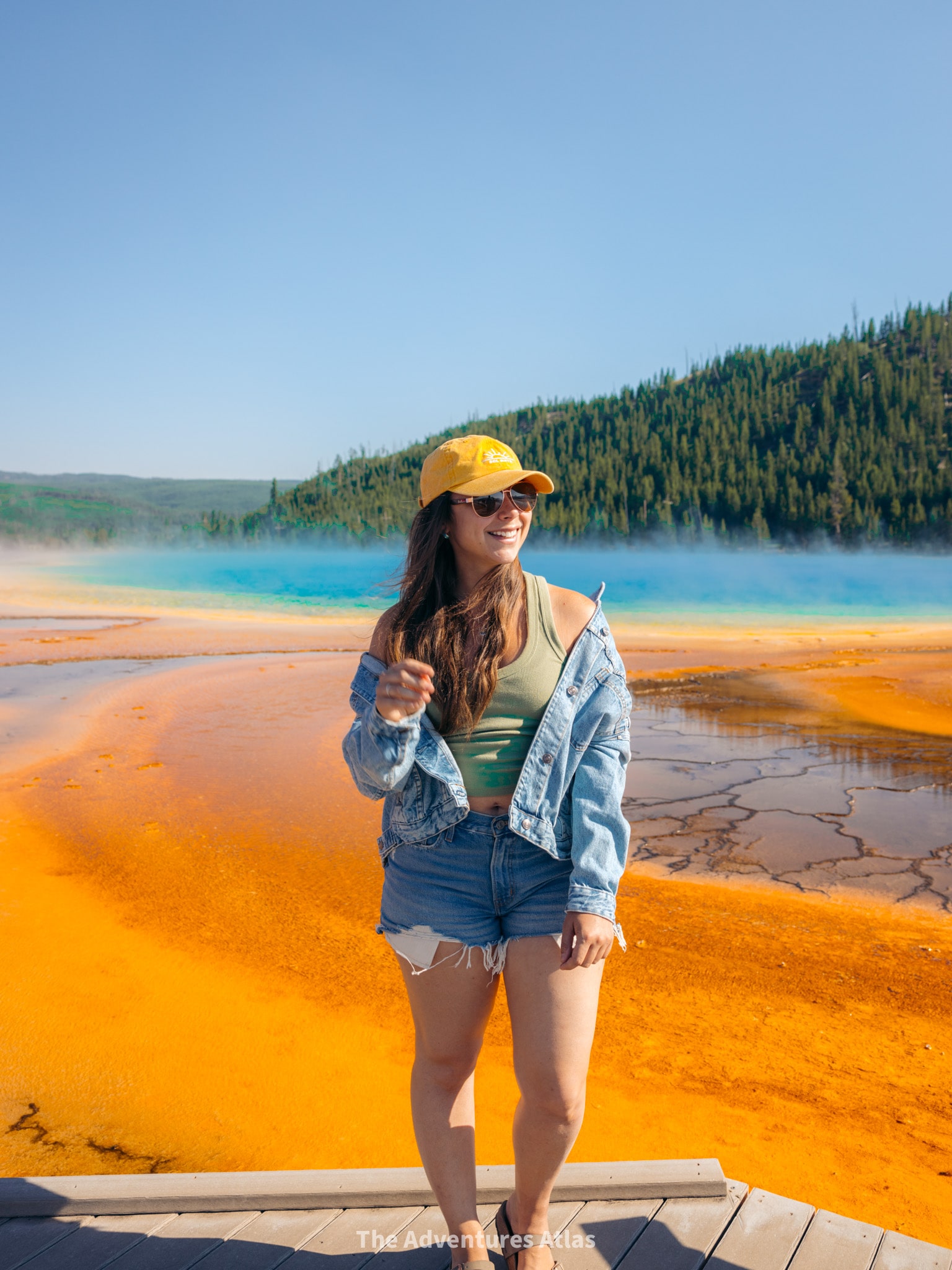
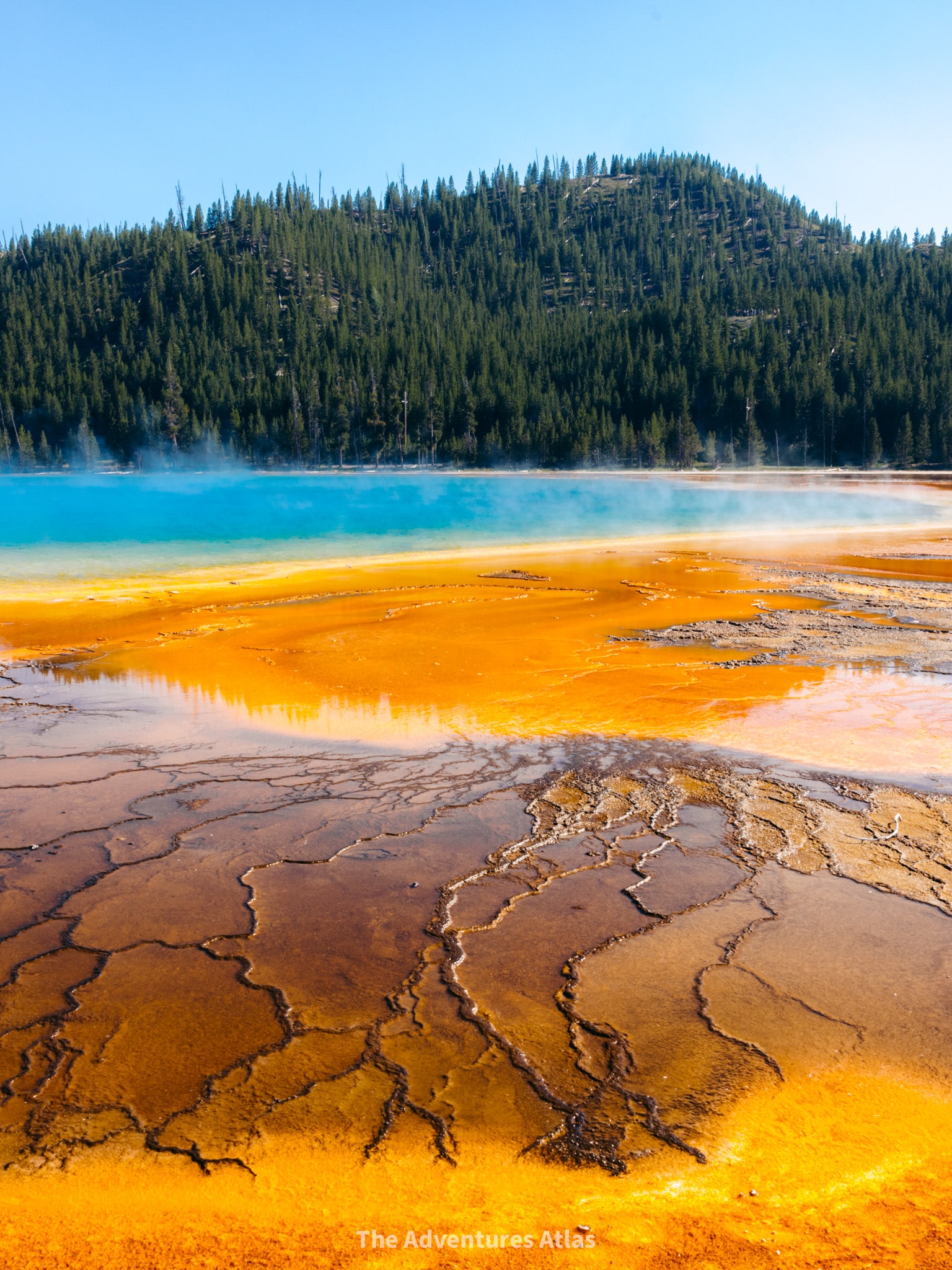
Grand Prismatic Spring from the boardwalk
Stop 3: Old Faithful (Upper Geyser Basin)
No trip to Yellowstone is complete without seeing Old Faithful! While not the park’s largest geyser, it’s the most famous because it erupts reliably about every 90 minutes. If you’ve never seen a geyser erupt, this is going to be an exciting stop for you. Each burst of water and steam can reach heights of 100 to 180 feet!
- Time Needed: 1 – 1.5 hours
. - Don’t Miss: The eruption, obviously! Check the predicted eruption times at the Visitor Center or on the NPS app as soon as you arrive.
. - My Pro-Tip: Don’t just leave after the eruption. The surrounding Upper Geyser Basin has the largest concentration of geysers in the world. Take a walk along the boardwalks to see other incredible features like the deep turquoise Morning Glory Pool, Bottlomless Pit, and Castle Geyser.
 Old Faithful in Upper Geyser Basin
Stop 4: West Thumb Geyser Basin
A lot of people skip this one, but it was one of my favorites. This unique geothermal area sits directly on the shore of the massive Yellowstone Lake. The contrast of the bubbling, colorful pools against the vast, blue water is stunning.
- Time Needed: 30-45 minutes
. - Don’t Miss: Our favorite spring was the Abyss Pool for its incredible depth and color, and the Fishing Cone, a geyser that erupts right out of the lake.
. - My Pro-Tip: This is a great spot to visit in the afternoon when other areas are packed. It’s more compact and generally less crowded. There were only a handful of other people here with us.
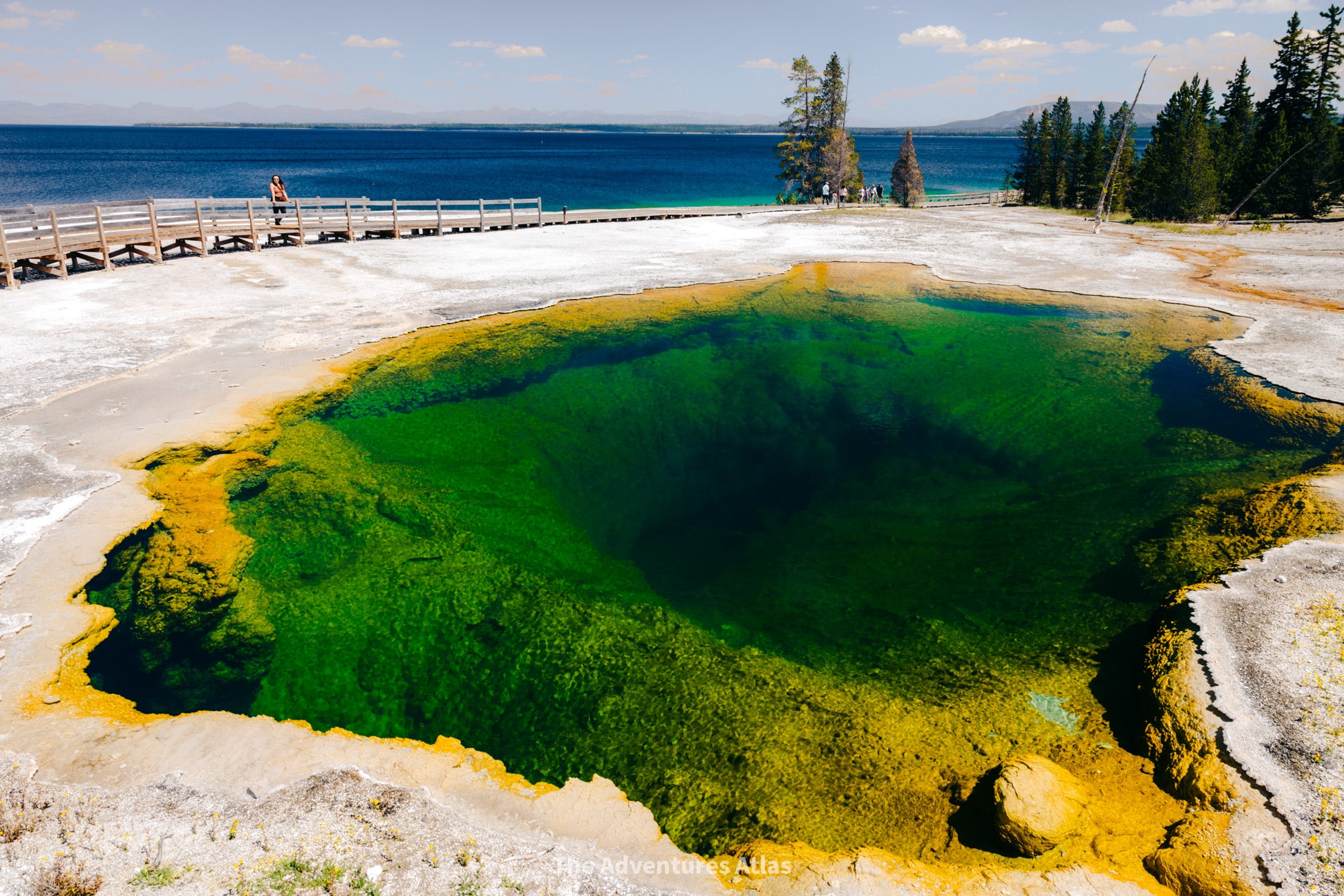 Abyss Pool on the shore of Yellowstone Lake in West Thumb Geyser Basin
Stop 5: Sunset in Hayden Valley
End your day in one of the best places for wildlife viewing in the park! Hayden Valley’s wide, open landscape is a prime habitat for bison, elk, and even bears, who are most active in the golden hour before sunset.
- Time Needed: 1-2 hours
. - Don’t Miss: Find a pull-off, turn off your car, and just be patient. The valley comes alive as the sun begins to set.
. - My Pro-Tip: Bring binoculars! You’ll be able to spot wildlife far in the distance. And remember to use a zoom lens to get great photos while maintaining a safe and legal distance. We love to use a 100-500mm telephoto lens to capture up close photos of wildlife.
By law, stay 100 yards (the length of a football field) away from bears, wolves, and nesting birds. 25 years from all other wildlife. We saw tons of people getting WAY too close to bison and elk in Hayden Valley. While they may look friendly, they can run really fast and be pretty aggressive!
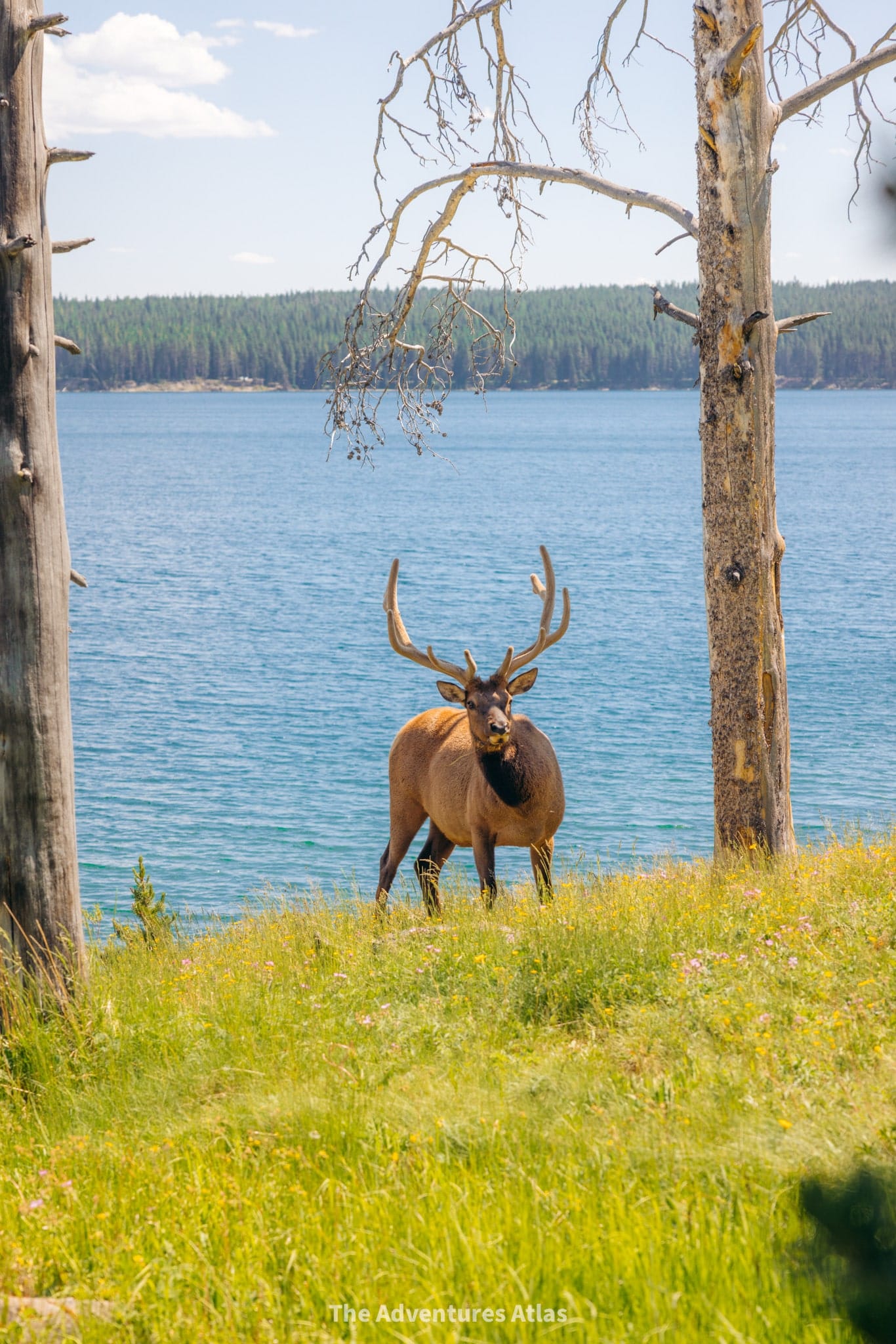
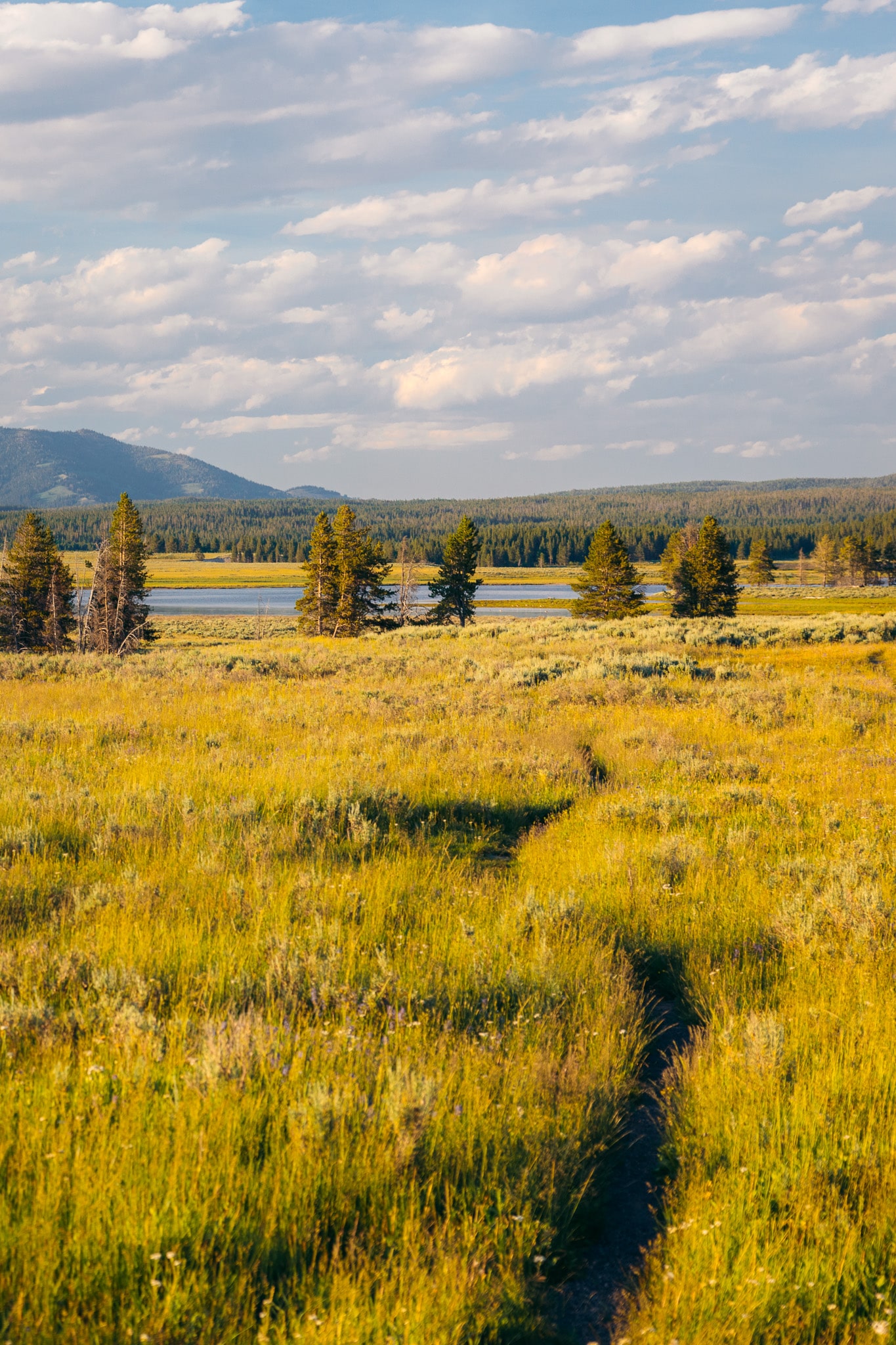
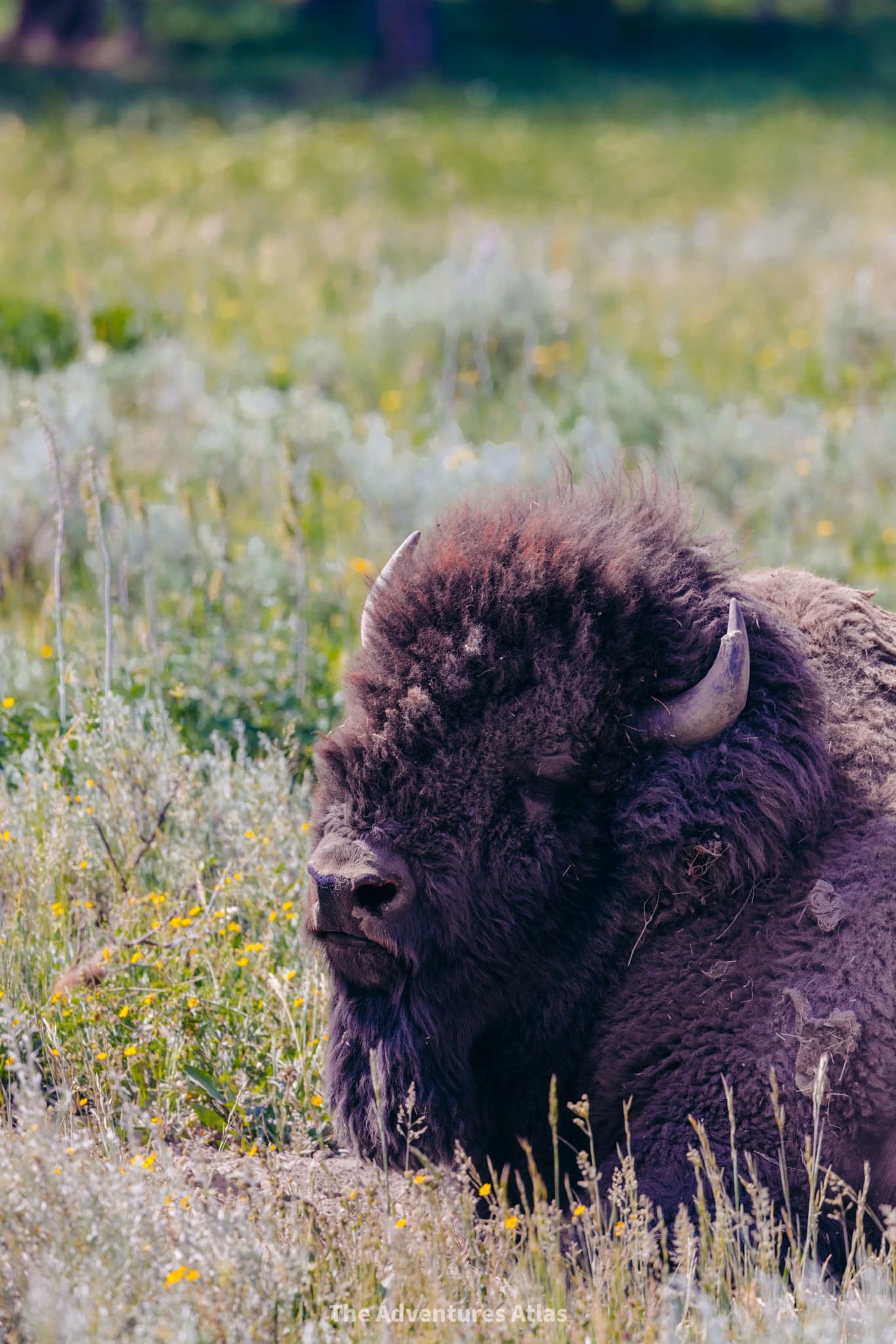
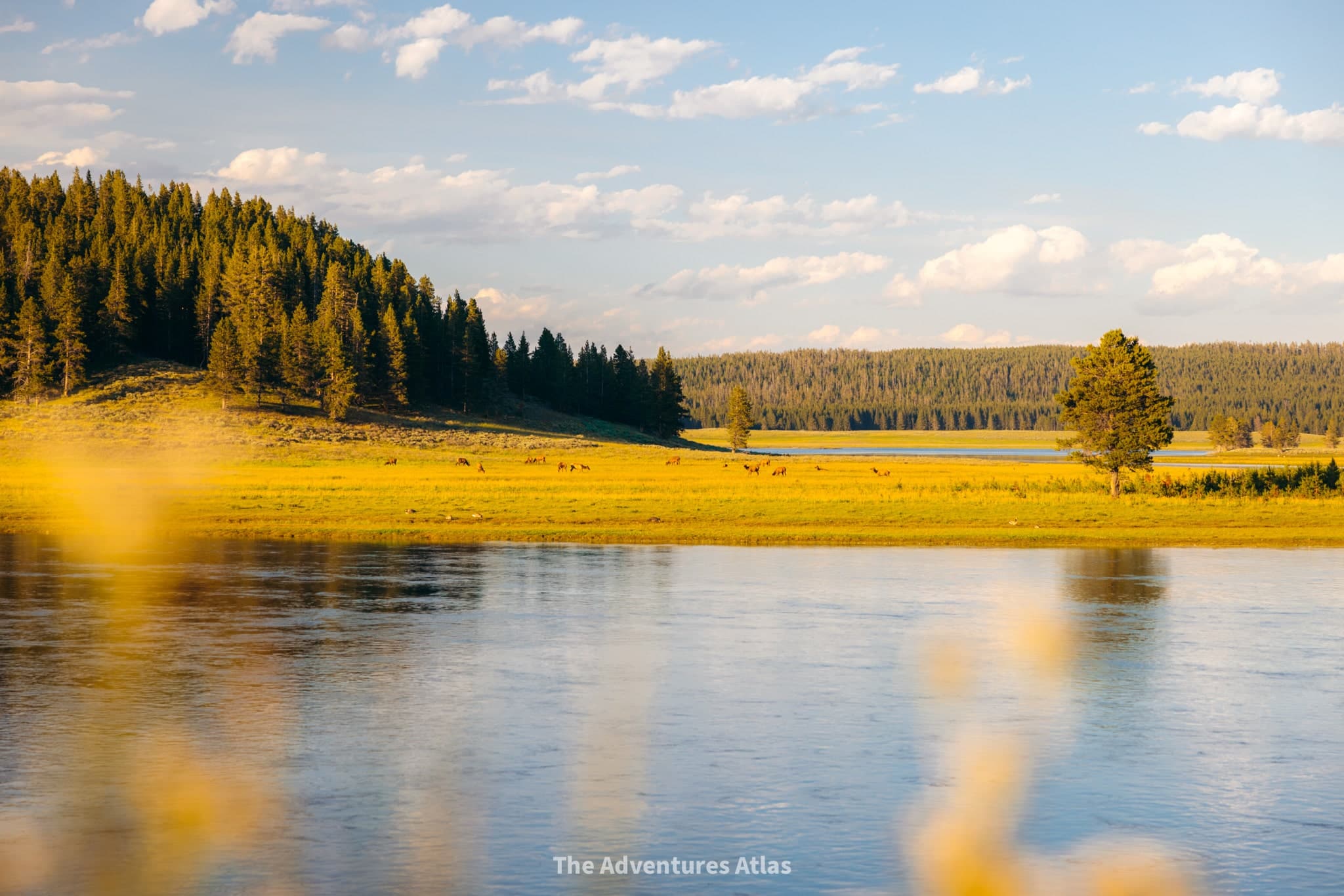 Wildlife in Hayden Valley at sunset. Taken with a 100-500mm lens
Where to Stay on Night 1
Day 1 ends at sunset in Hayden Valley, which puts you on the eastern side of the park’s Lower Loop. To set yourself up perfectly for Day 2 and avoid a long, dark drive, your best bet is to stay nearby.
Inside the Park (Most Convenient)
- Lake Village & Canyon Village: Staying at one of the lodges here (like the Lake Yellowstone Hotel or the cabins at Canyon Lodge) is by far the most convenient option. You’ll be just a short drive from your final stop and perfectly positioned to start Day 2 at the Grand Canyon of the Yellowstone. These book up months (sometimes a year) in advance, so plan ahead.
Camping Inside the Park
- Canyon Campground & Bridge Bay Campground: These are the two closest campgrounds. Both require reservations, which you should make on the official Yellowstone Lodges website the moment they become available, as they fill up instantly for July.
Outside the Park (Budget/Last-Minute Option)
- West Yellowstone, MT: If park lodging is full or out of budget, West Yellowstone has the most hotel options. Be aware: this will require about a 1-hour drive back west from Hayden Valley in the dark and another 1-hour drive back east to start Day 2.
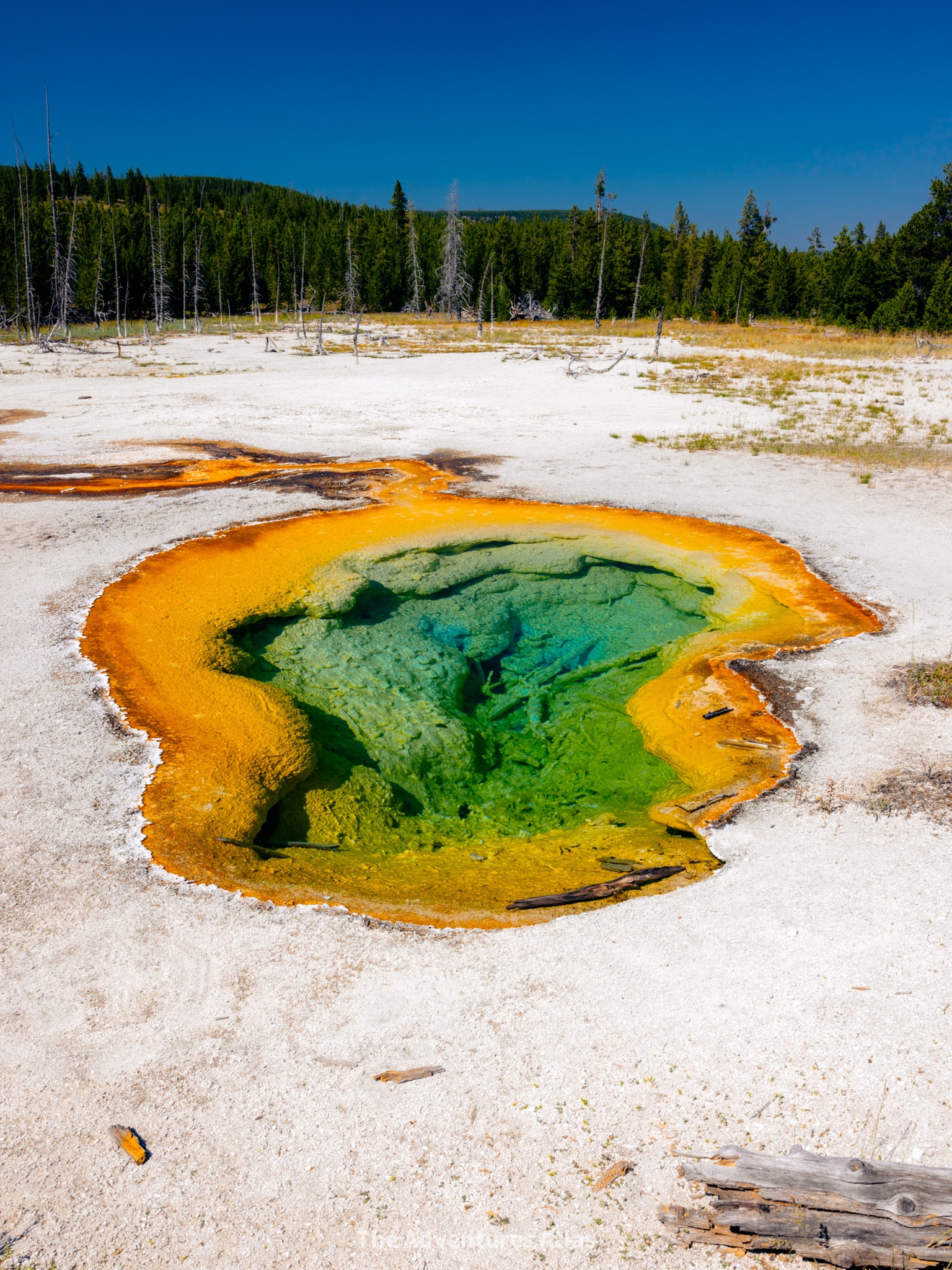
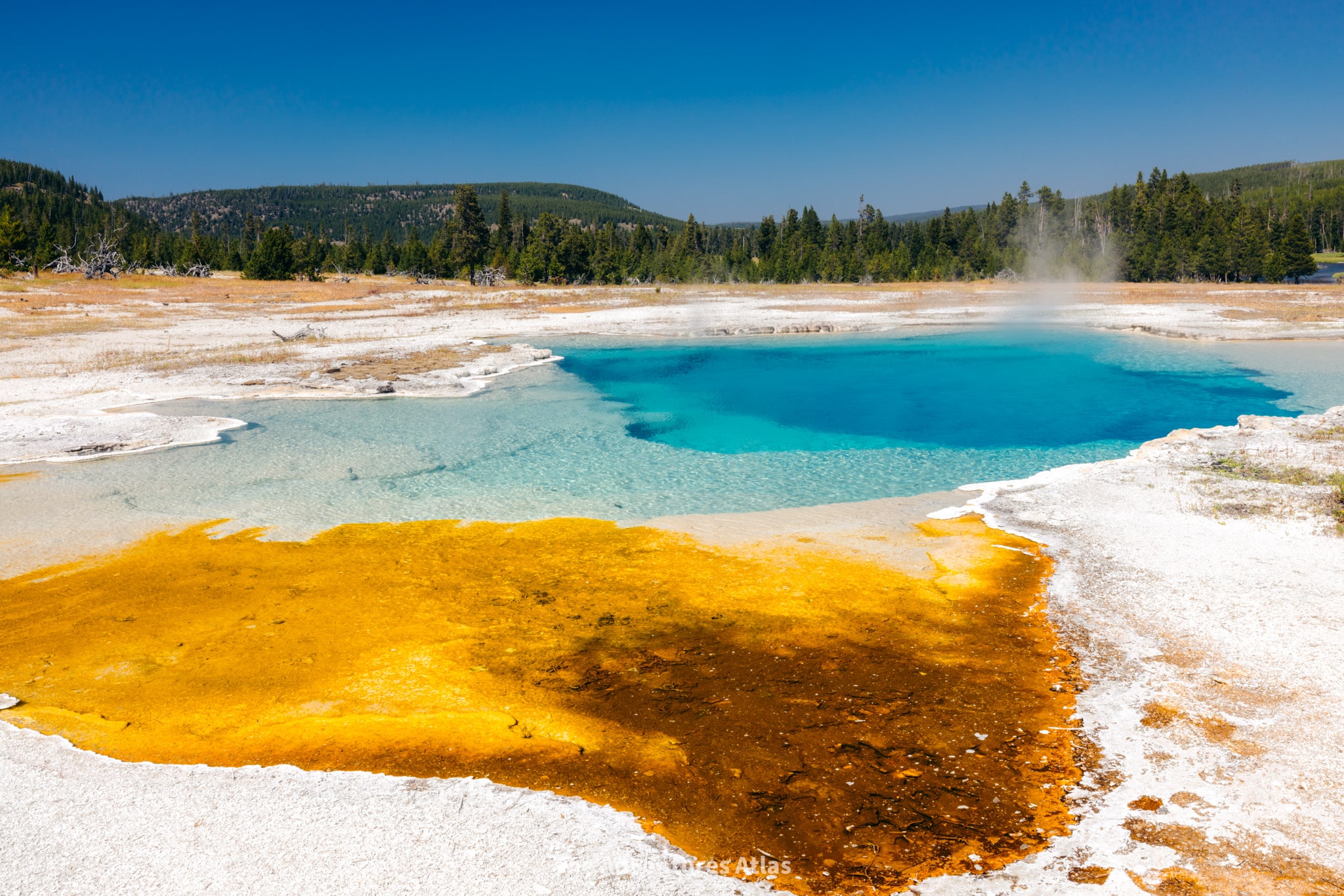 Colorful pool in Lower Geyser Basin
Day 2: Canyons, Waterfalls, and the “American Serengeti”
Day two focuses on the dramatic landscapes of the Upper Loop, from the “Grand Canyon of the East” to the wildlife-rich plains of the Lamar Valley.
Stops on this day are laid out clockwise, starting from Hayden Valley. If you stayed on the east side of the park, you’re right where you need to be. If you stay in West Yellowstone, you will have to backtrack about 1 hour to get to Grand Canyon of the Yellowstone.
Stop 1: Grand Canyon of the Yellowstone
The Grand Canyon of the Yellowstone is a large canyon that was carved out by the Yellowstone River over thousands of years. It’s particularly famous for its colorful canyon walls and two impressive waterfalls (Upper Yellowstone Falls and Lower Yellowstone Falls).
This is one of the park’s most iconic and visited attractions, so it gets CROWDED. Get here before 9AM to beat the crowds and tour buses.
- Time Needed: 2-3 hours
. - Don’t Miss: You need to see the canyon from both rims. On the South Rim, drive to Artist Point for the most iconic, sweeping view of the Lower Falls. On the North Rim, walk the short but steep trail to the Brink of the Lower Falls to feel the raw power of the water. Overlooks are best along the North Rim, it’s not really worth it to hike here.
. - My Pro-Tip: For the best photo, Artist Point is a must. For the best experience, the Brink of the Lower Falls is unforgettable.
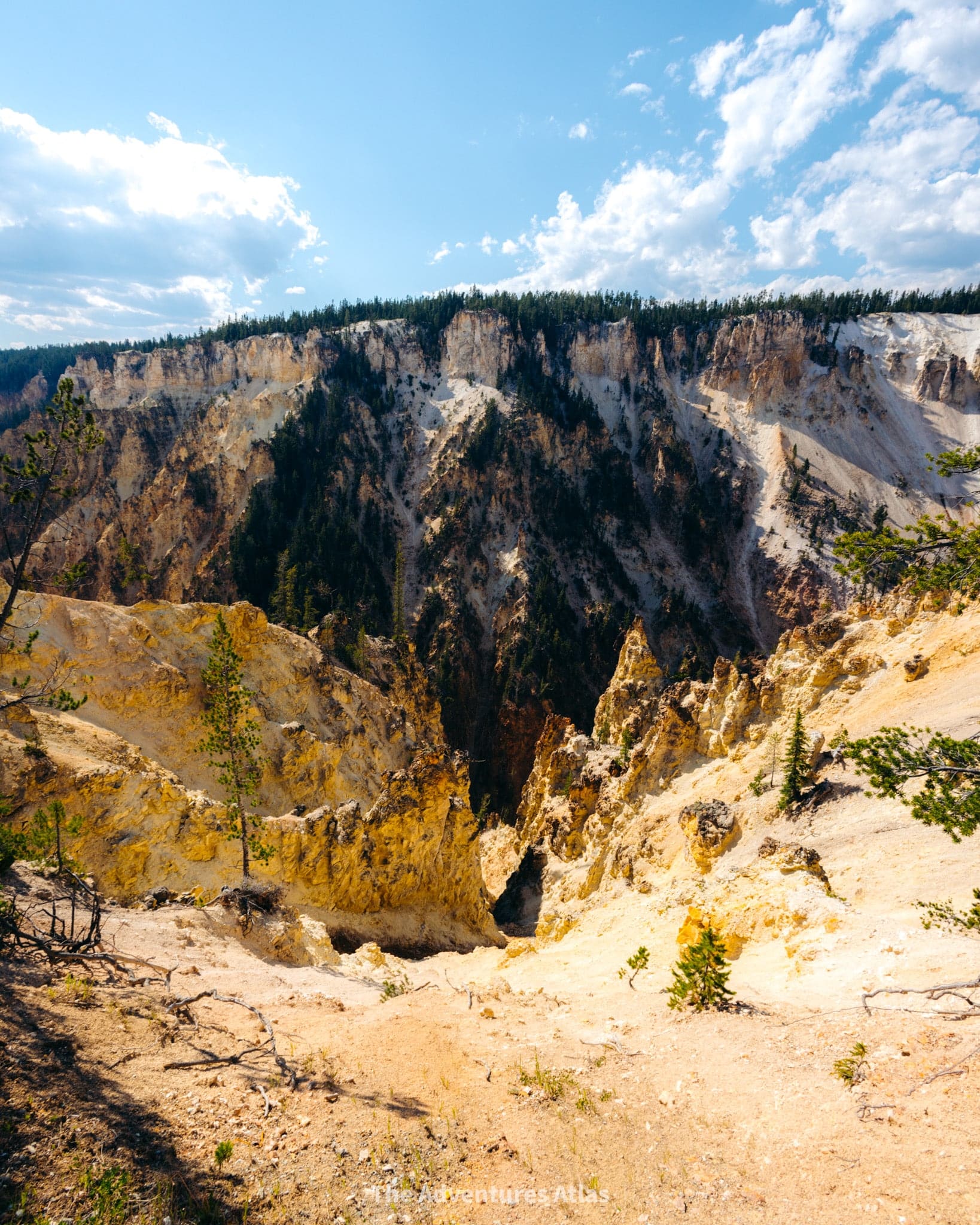
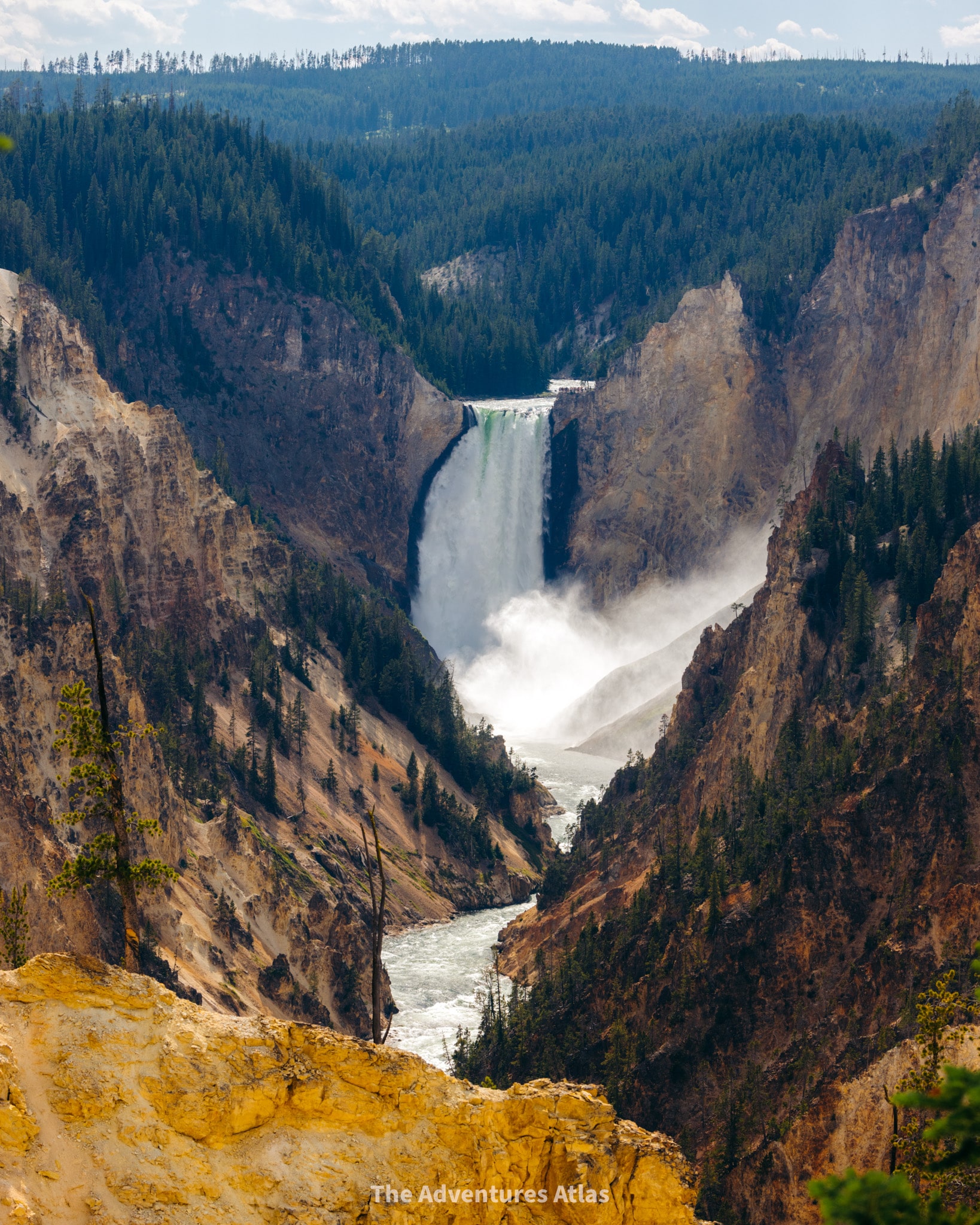
Grand Canyon of the Yellowstone from Artist Point viewpoint
Stop 2: Norris Geyser Basin
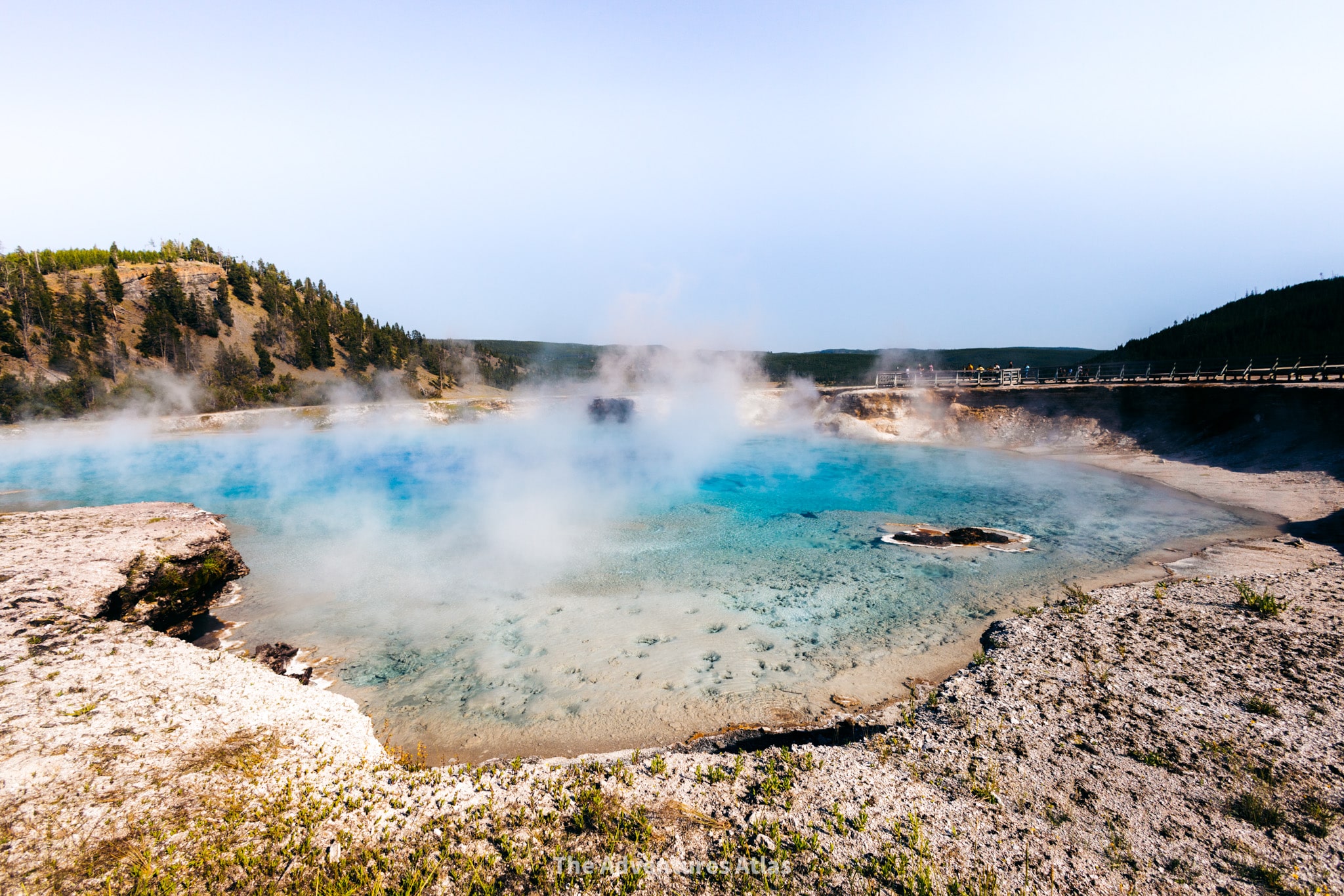
Next, drive west toward Norris Geyser Basin. This is the hottest, oldest, and most dynamic geothermal area in Yellowstone – some features are over 115,000 years old and 459 degrees F! It’s a fascinating, almost alien landscape that I consider highly underrated.
- Time Needed: 1 hour for Porcelain Basin; 2 hours for both basins.
. - Don’t Miss: The basin is split into two parts. If you’re short on time, I recommend focusing on the Porcelain Basin, a barren, milky-colored landscape with noisy fumaroles and steaming vents. The walk is about 2/3 miles and takes you past several notable features, including Ledge Geyser, Whirligig Geyser, and the vibrant, steaming turquoise waters of the Blue Geyser Pool.
. - My Pro-Tip: If you have time, walk the loop through the Back Basin to see Steamboat Geyser, the world’s tallest active geyser. It erupts unpredictably (sometimes it erupts a few times a months, sometimes it takes years), but it’s impressive even when dormant.
Note: If you’re getting hungry, you can stop in the Canyon Village area as there are some amenities here.
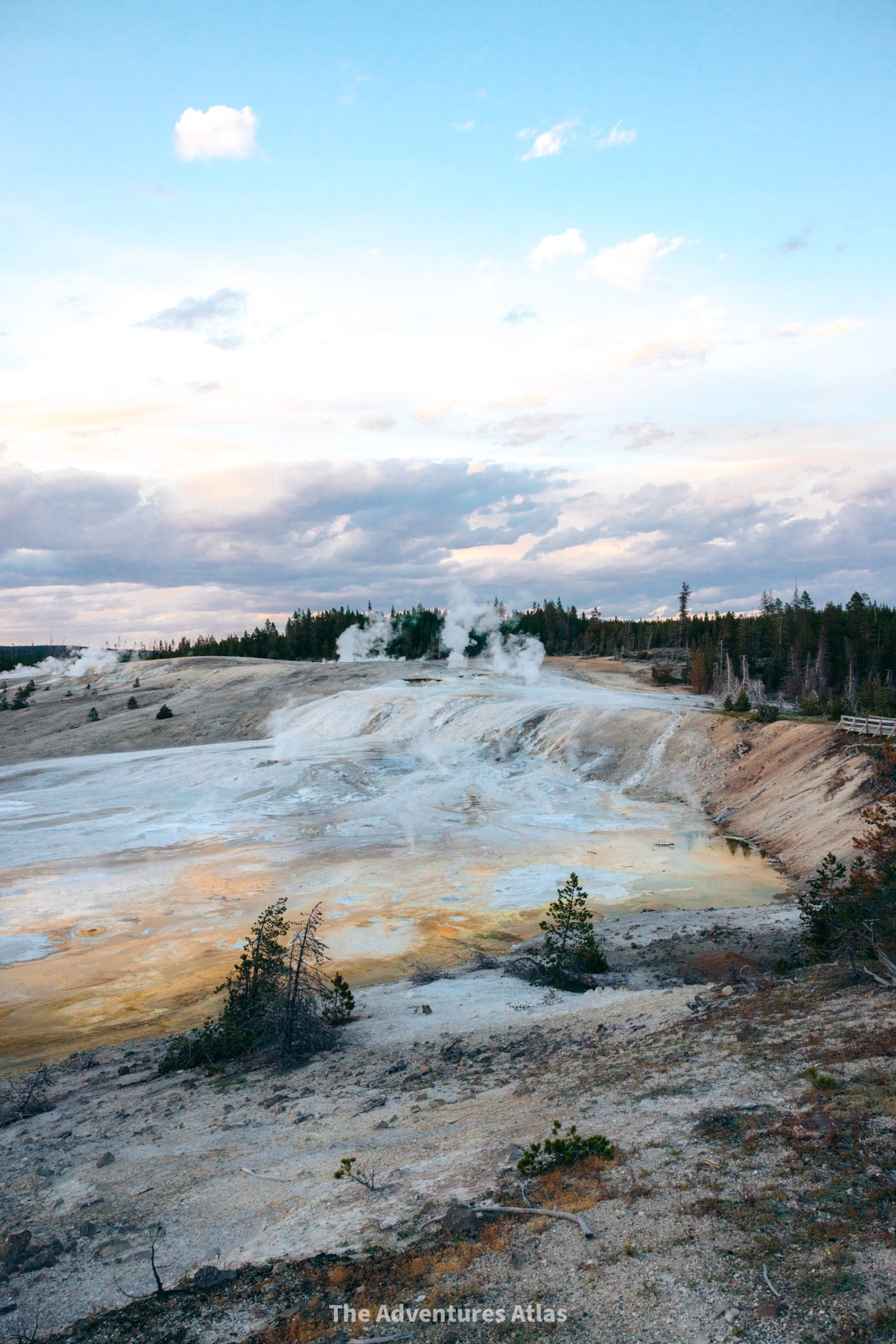
Itinerary Tip: Norris Geyser Basin is one of the best places for sunset in Yellowstone. It’s also one of the quietest -we ended up being the only people on the entire trail for sunset in peak summer. If you don’t mind skipping Lamar Valley, you can save Norris Geyser Basin for last on this day, which will also put you back near the West Entrance.
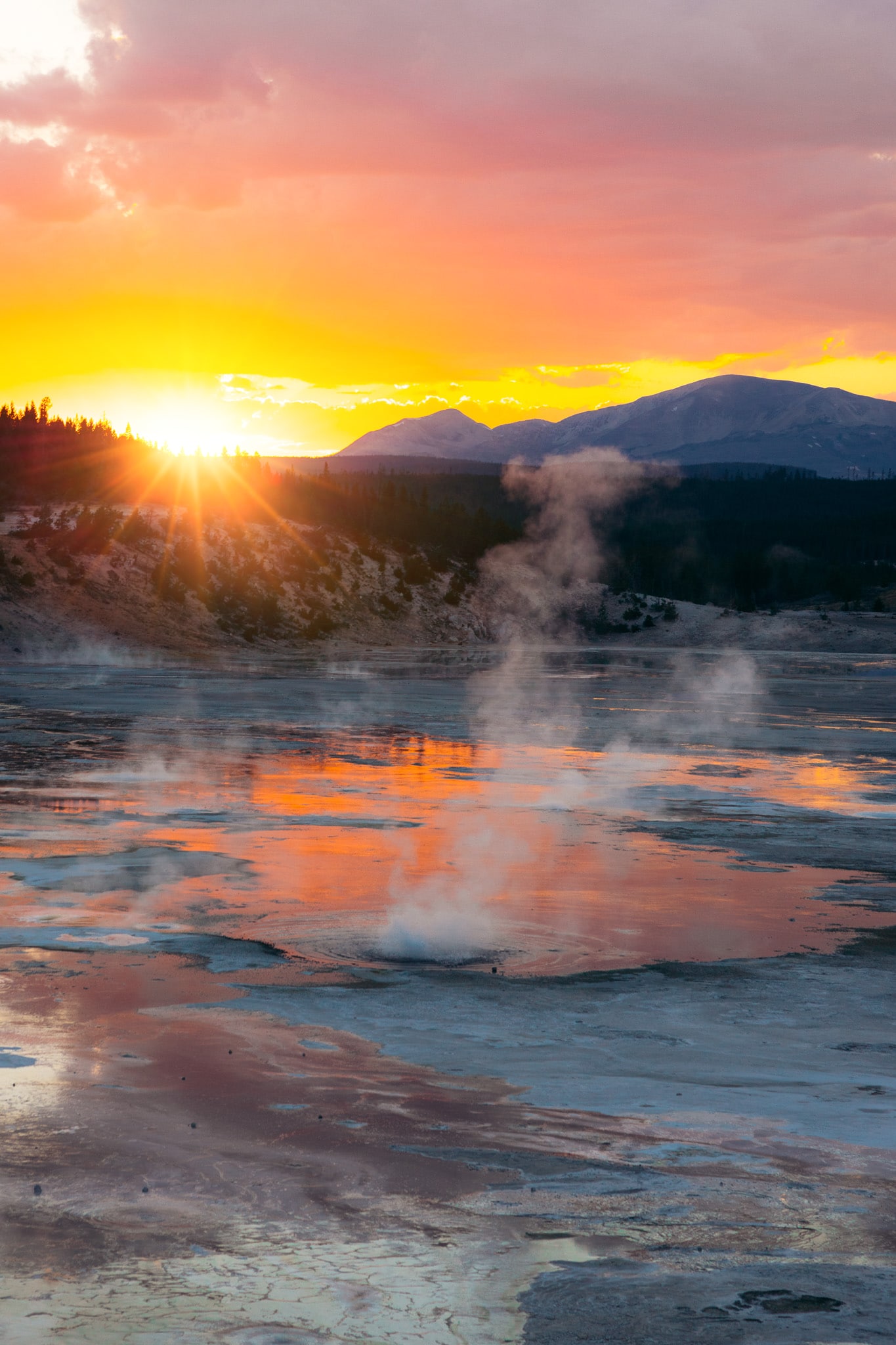
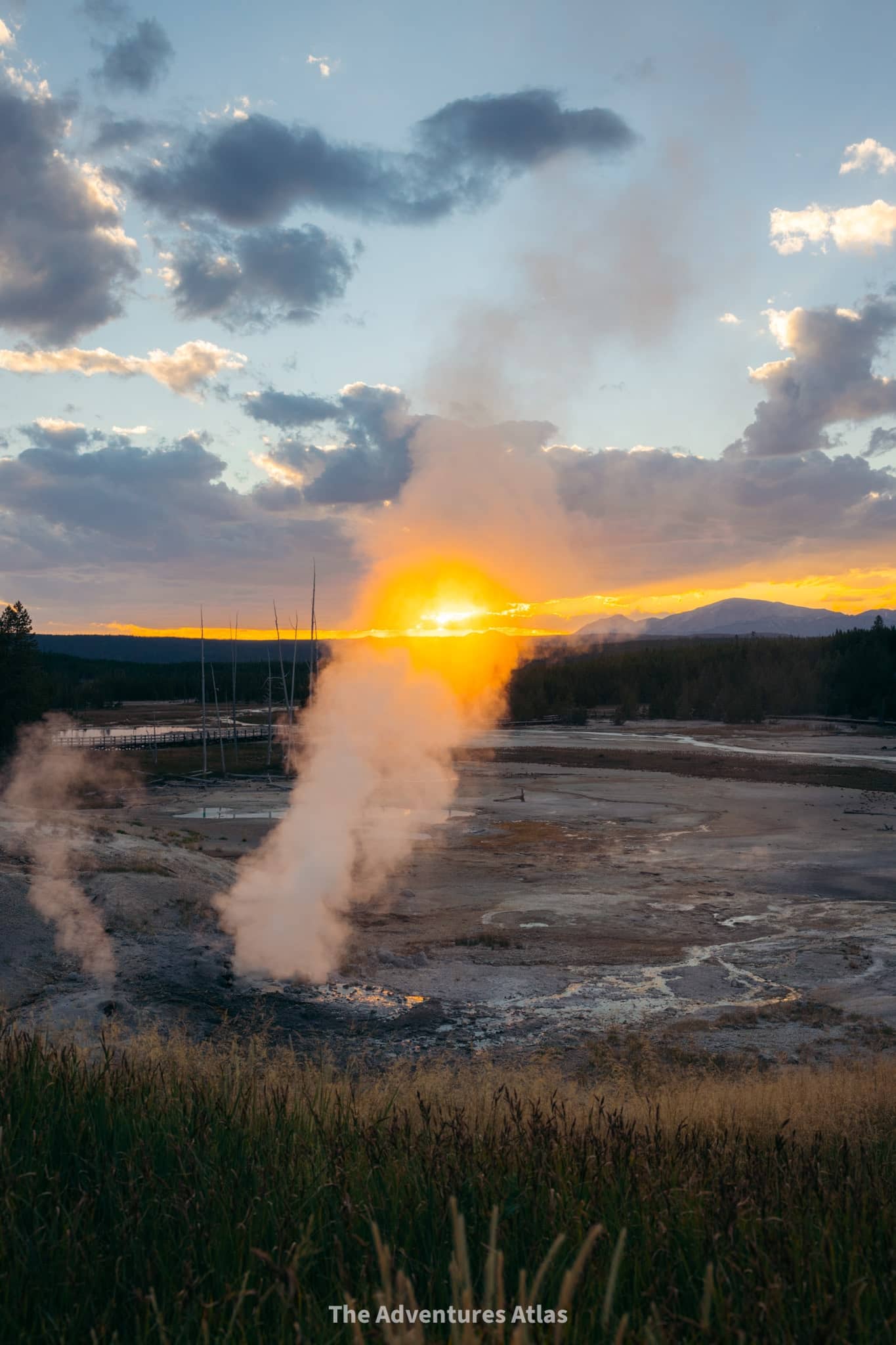
Stop 3: Mammoth Hot Springs
Located in the northwest corner of the park, Mammoth Hot Springs is a completely different kind of geothermal area. Here, hot water cascades over a series of travertine terraces, creating what looks like a living, inside-out cave.
- Time Needed: 1 hour
. - Don’t Miss: Stroll along the boardwalks of the Lower Terraces to see formations like Minerva Terrace up close. This is one of the most famous and photogenic spots in this area. Then, do the scenic Upper Terrace Drive, a one-way loop that allows you to see a variety of terraces from different vantage points. This is for cars only (no RVs, trailers or buses allowed).
. - My Pro-Tip: Parking at the Lower Terrace is extremely limited. It’s often faster to park in a designated pull-off along the road and walk instead of waiting for a spot. If you have extra time, stop at Undine Falls. It’s visible from Grand Loop Road about 4 miles southeast of Mammoth Hot Springs.
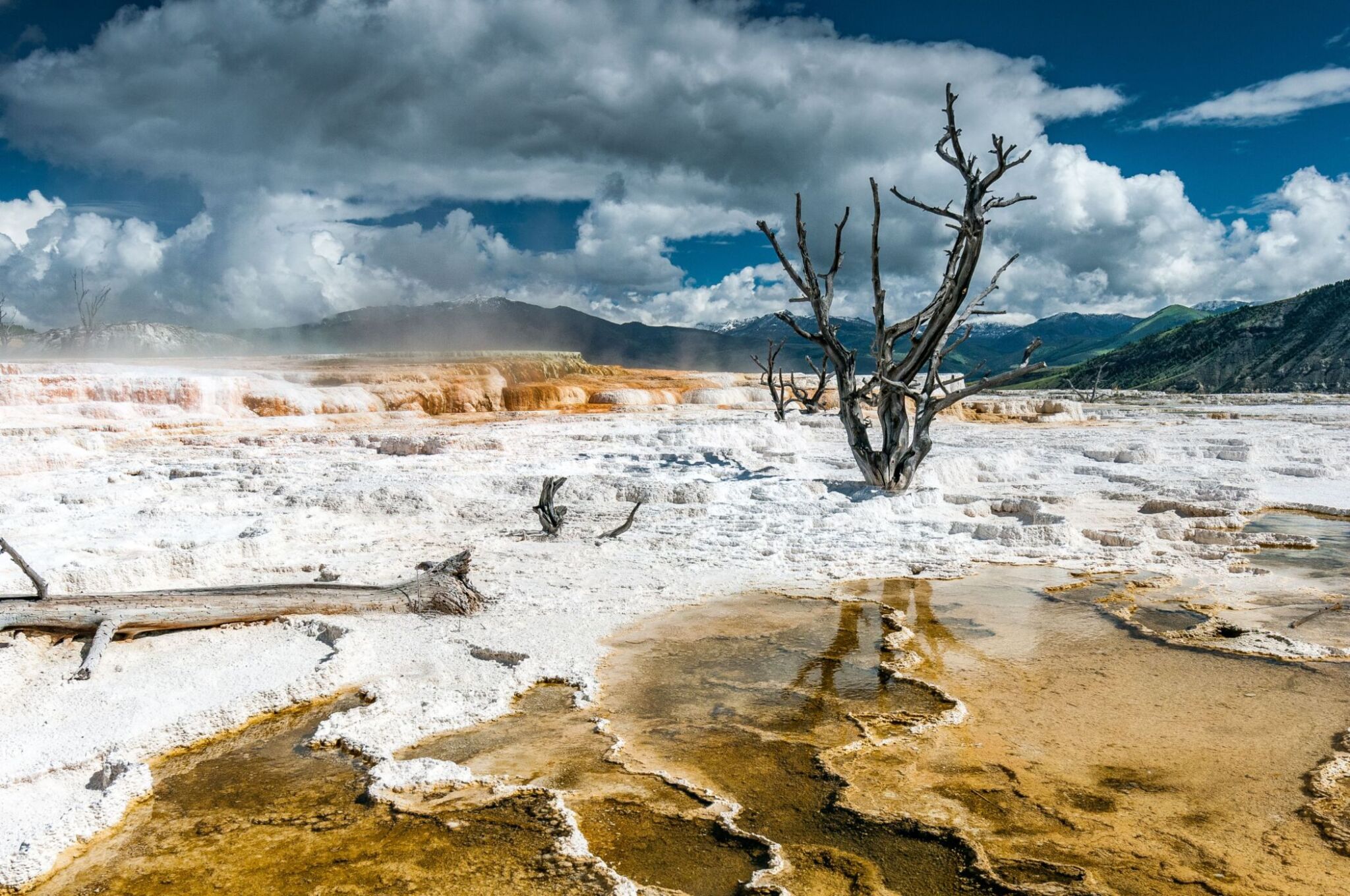 Mammoth Hot Springs, Yellowstone
Stop 4: Sunset in Lamar Valley
End your trip in the “Serengeti of North America.” Lamar Valley is, without a doubt, the best place to see wildlife in Yellowstone. Its vast, sweeping landscape is home to huge herds of bison, pronghorn, and the famous Lamar Valley wolf packs.
- Time Needed: 2-3 hours
- Don’t Miss: The hours just before sunset are prime time. Take your time driving through the valley, using the many pull-offs to scan the hillsides with binoculars.
- My Pro-Tip: Arrive about 1-2 hours before sunset and take your time driving through the valley. If you see a group of cars pulled over with spotting scopes out, pull over too! They’ve likely spotted a wolf or a bear. This is your best chance to see one.
Where to Stay on Night 2
Your 2-day Yellowstone adventure ends at sunset in the magnificent Lamar Valley, located in the far northeast corner of the park.
Where you stay tonight depends on where you’re headed next.
Inside the Park
- Roosevelt Lodge Cabins: This is the closest in-park lodging to Lamar Valley. It offers a rustic, historic experience and puts you right in the heart of the park’s wild northern range.
Outside the Park (Gateway Towns)
- Cooke City, MT (29 miles away): Located just past the Northeast Entrance, Cooke City is the closest town to Lamar Valley. It’s a small, rustic town that feels like a true outpost at the edge of the wilderness.
. - Gardiner, MT (48 miles away): Located at the North Entrance, Gardiner is about an hour’s drive from Lamar Valley. This is your best bet for more restaurants, amenities, and a wider range of lodging options.
Camping (If you’re adventurous)
- Pebble Creek & Slough Creek Campgrounds: These are two small, first-come, first-served campgrounds located right near Lamar Valley. They are highly sought after by wildlife photographers and wolf watchers. Arrive very early in the morning to have any chance of snagging a site.
. - Dispersed Camping: If you have a campervan or tent, there are dispersed camping options on the National Forest land outside the North and Northeast entrances.
Frequently Asked Questions
Is 2 days really enough time in Yellowstone?
While you can’t see everything, 2 days is absolutely enough time to see all the major highlights if you follow a smart itinerary and start your days early. This plan will leave you feeling like you’ve had a complete and incredible Yellowstone experience.
My advice is start your days early (around 7AM) and stay out for sunset to make the most of your time and see as much as you can in 2 days.
Keep in mind that the number of days you need in Yellowstone ultimately depends on your travel style. If you prefer a slower pace, want to camp, or plan on hiking longer trails, consider extending your stay to 3 or 4 days.
What if I have more than 2 days?
If you have 3 or 4 days, I would recommend slowing this itinerary down. Spend more time exploring the geyser basins or add one of the incredible hikes, like the trail to Fairy Falls or Bunsen Peak. With 5 or more days, you can explore beyond the park and drive the stunning Beartooth Highway or head south to visit Grand Teton National Park.
Where should I stay for this itinerary?
For this route, the most convenient option is to stay near Canyon Village or Lake Village inside the park after Day 1. This positions you perfectly to start Day 2 without a long backtrack. If you’re looking for more budget-friendly options, West Yellowstone is the best gateway town.
What is the best way to get to Yellowstone?
You will need to fly into one of the regional airports and rent a car. The best options depend on your itinerary. For this specific route, flying into Bozeman, MT (BZN) or Jackson, WY (JAC) are your most convenient choices.
For a full breakdown of all the options, check out my guide to the Nearest Airports to Yellowstone National Park
What’s the best way to get around the park?
You will need your own vehicle. We rented a campervan through RVshare, which gave us the ultimate freedom to explore at our own pace and saved us from having to book expensive park lodges. Otherwise, you’ll need to book a car.
The park doesn’t have a shuttle service, and there aren’t any local buses that serve the area. So if you don’t have a car, if you don’t have a car, your best bet is to book a guided tour from West Yellowstone or Jackson.
More guides for your trip to Yellowstone
Getting there: Nearest Airports to Yellowstone National Park
Good to know: Yellowstone National Park Entrances: Which is Best?
Prepare for your trip
Road trip apps: 15 Useful Apps to Download Before Your Next Road Trip (for Free!)
Backpack recommendations: Best Hiking Backpacks for Women in 2023
Day hike essentials: What to Pack for a Day Hike: Essential Gear and Complete Packing List
More USA Road Trip Guides
Las Vegas to Sedona: Las Vegas to Sedona Road Trip (3 Jam-Packed Itineraries to See it All in Less Time)
Related Posts
WANT TO SAVE MONEY TRAVELING?
Check out my list of reliable budget-friendly travel resources that are guaranteed to save you the most money, without compromising your experience.